My most recent series of passages covered the phases of end times events prior to the Day of the Lord. For additional context in considering this time period as well as the Day of the Lord/time of Revelation itself, it is helpful to understand the adversary’s kingdoms. It is reasonable to believe that these are already well-established as we approach the end of the age.
Jesus foretold that at the time of the “beginning of sorrows” (i.e. travailing in birth pains), a time he said is still not yet “the end,” that we will see “nation rising against nation and kingdom against kingdom” among other signs. These nations and kingdoms involved will all be various pieces serving in bondage to a one-world Satanic kingdom that will war against and cannibalize itself. It will also war against the Lord, his anointed remnant and all believers.
The book of the Prophet Daniel is a good place to search and establish an understanding of these major kingdoms. Daniel’s visions and interpretations describe events related to these that are applicable for the end times. Although some immediate fulfillment came even in Daniel’s time, there are several indications that his visions still apply at the time of the end. Daniel was told twice by an angel, “But thou, O Daniel, shut up the words, and seal the book, even to the time of the end.” These end times are those about which God said through Ezekiel, “the effect of every vision is at hand.”
Speaking of Ezekiel, I made the point in my passages entitled, Ezekiel’s Personal and Prophetic Story, that the overriding theme his prophecies describe is as follows:
The God of the universe will be taking back his land and his inheritance for a coming heavenly Kingdom (under his Son Jesus Christ’s reign), and will destroy the counterfeit kingdom constructed by those who have rebelled against him and have persecuted his saints and remnant servants.
In fact, through Daniel and in the book of Revelation we are told several times that the saints will inherit the Kingdom. A strong point made through Daniel is that it is only the one sovereign God who both establishes as well as takes down kingdoms and kings. He gives kingdoms to “whomever he will” (Dan. 4:17) or “whomever he wishes” (Dan. 4:29). Those who do not seek for and adhere to his plan have their power removed.
The books of Daniel and Revelation, especially, describe attempts at establishing a counterfeit world kingdom at the time of the end when the Lord’s coming Kingdom and spiritual temple will slowly develop on earth. This will happen through spiritual, behind-the-scenes means until it finally fully arrives alongside Jesus Christ from heaven. The adversary’s kingdom will be destroyed.
In the meantime, historical patterns continue in the last days as we find kingdoms and nations warring. Additional signs include the persecution of Christ’s faithful and those of the house of Israel. As believers who will face severe headwinds and persecution, we can rely on another strong point made through Daniel; that is, the “wise will understand.” Daniel, who was greatly loved by God, also observed that God, “gives knowledge to those who have understanding” (Dan. 2:19). About wisdom and understanding somewhat related to the adversary’s ‘metal’ kingdoms that I will discuss in this series, King Solomon described, “How much better is it to get wisdom than gold! and to get understanding rather to be chosen than silver!” (Prov. 16:16). Otherwise, if we find ourselves searching, through Daniel we are further told that the wise will “instruct many” in the last days.
The Four Kingdoms
In this passage, I will summarize the end times application of the four major kingdoms/kings described by Daniel across three visions (incl. one of King Nebuchadnezzar about the “latter days”). In a couple of cases, Daniel tells us what these kingdoms represent according to symbolism that he saw. A quick summary of these and their associated symbols is as follows:
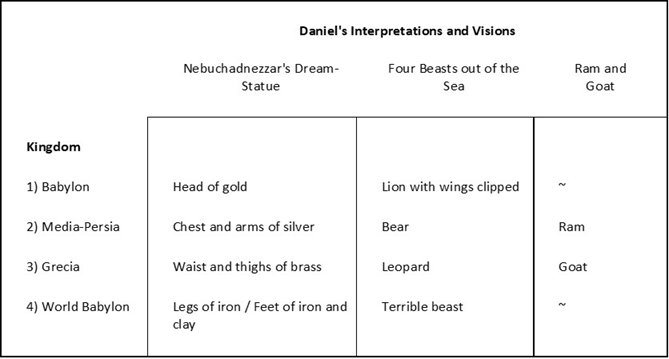
There is much in the way of interpretation of these kingdoms that may be done in an attempt to achieve understanding for the end times. The various metals of the statue, the corresponding body parts, and the various types of animal creatures presented through Daniel all contain meaning and provide clues about the nature of the respective kingdoms at play: Babylon; Media/Persia; Grecia; and world Babylon.
While these kingdoms are distinct, it is also important to view them as part of one world kingdom. We have several indications in scripture that these should be viewed holistically. They are somewhat successive, yet overlapping and coexisting. At the time the final beast arises as described by John the Revelator, it appears to have blended characteristics of each of the four creatures in Daniel’s vision summarized above:
And the beast which I saw was like unto a leopard, and his feet were as the feet of a bear, and his mouth as the mouth of a lion: and the dragon gave him his power, and his seat, and great authority. (Rev. 13:2)
As a whole, the “great image” of the statue in Nebuchadnezzar’s dream described as “very bright” and “terrible” by Daniel can be viewed as one kingdom with kingdoms within. This is why we are told that “in the days of these kings” when God’s eternal Kingdom comes that his will consume all of the adversary’s kingdoms. Specifically, the stone that is “cut out of the mountain without hands” will break in pieces the iron, brass, clay, silver, and the gold at the time of a final harvest at the “summer threshing floor” (Dan. 2:35).
In his vision of the “four great beasts,” Daniel started his description of this reciting the “four winds of heaven” upon the great sea. This is a term used several times in scripture with an end times meaning associated with heavenly- and spiritual-related events. Daniel then introduces the four beasts “out of the sea” who are the kings that “arise” out of the earth. Thus, this sets up part of the kingdom war where the heavenly realm meets the earthly realm in some sense.
The end times, interrelated nature of the adversary’s kingdoms is also implied in the other visions shown in the table above. While the first three kings Daniel mentions will eventually have their respective kingdoms’ “dominion” taken away and be destroyed by a final, “exceedingly dreadful” one, we are told that these kings’ lives will be prolonged for “a season and time.” Additional indicators of concurrent kings and kingdoms is seen in the final vision of the Ram and Goat, the second and third respective kingdoms (of four); it is obvious that these will exist at the same time, given that they war against each other; this is a time at which world Babylon continues to be in play as well.
While I will describe end times meaning for each of the four kingdoms separately in this series, you may keep in mind the general idea that going through a purging and refining process that is administered by the adversary will ultimately lead an individual to the freedom and liberty offered by the Lord’s harvest. This will be an escape from oppression, bondage and the “sword” of the adversary’s drunken spirit and intense desire for control. The two opposing spiritual kingdoms, also reflected by a war in the heavens at this time, will come apart and finally separate altogether. Meanwhile, you can see how the purging process for individuals out of the adversary’s ‘metal’ kingdoms may have been symbolically indicated in ancient times through Eleazar the Priest and Moses, speaking to Israel’s “men of battle”:
Only the gold, and the silver, the brass, the iron, the tin, and the lead, Everything that may abide the fire, ye shall make it go through the fire, and it shall be clean. (Num. 31:22-23).
Here, recall that Jesus came to baptize with fire. Gold, silver, bronze and iron are parts of the statue from its head to toes representing the sub-kingdoms that a remnant of Israel and Christ-believers will have to be purged out of. At a personal level, a realization of why Jesus’ declared mission was to “free the captives” along with an understanding of “cunning” works of wisdom will be required. The meaning of the word “cunning” as used in some cases in scripture suggests a ‘going forth,’ ‘breaking free’ or ‘loosening.’ A purging and subsequent release will allow the Lord’s faithful to become a “vessel unto honour, sanctified, and meet for the master’s use, and prepared unto every good work” (2 Tim. 2:21). This is consistent with why God exhorts his faithful, “Come out of her my people” (Jer. 51:45). Then, at the time that the Lord’s redeeming glory arises and his people return to the holy land, this is described as, “all they gather themselves together, they come to thee.” This is the time prophesied by Isaiah when the “abundance of the sea is converted.” The Lord says:
For brass I will bring gold, and for iron I will bring silver, and for wood brass, and for stones iron: I will also make thy officers peace, and thine exactors righteousness. (Is. 60:17)
Meanwhile, those who are corrupt, powerful kings in the last days will be like Nebuchadnezzar’s son Belshazar whom Daniel called out for praising these worldly gods and idols of gold, silver, brass and iron, “which see not, hear not and know not” (Dan. 5:23). These are the same about which King David spoke, observing, “They have ears, but they hear not: noses have they, but they smell not, They have hands, but they handle not: feet have they, but they walk not: neither speak they through their throat” (Ps. 115:6-7). Some of the contrast between these oppressors’ kingdoms versus individuals who choose to be purged out of them to join the Lord can be seen below and the rest of this series.
Babylon – Head of Gold (Statue) and Lion with Wings Plucked
To begin, the name ‘Babylon’ itself has meaning within that includes ‘confusion’ or ‘confounding.’ This will be important as to the end state of Babylon that will see destruction and desolation as an outcome. In the meantime, there is also meaning within this name that includes ideas such as ‘overflowing,’ ‘anointing,’ and ‘mingling’/’mixing.’ (The latter two may be related to ‘Israel’s condition, especially within the nation of Babylon, including application for the end times. On this site, I have described ‘Ephraim’ as a proxy of Israel’s ‘northern kingdom’ within last days Babylon. I have also already described Babylon overall as a nation (likely the U.S.), city and a world kingdom).
In Daniel, ‘initial’ Babylon in the end times is symbolized in two visions. The first case observed is a head of gold on the statue image in Nebuchadnezzar’s dream. Daniel said that this represented the king. Babylon is also symbolized through Daniel (Chapter 7) as a lion with its wings plucked, standing on two feet, with a man’s heart given to it.
In interpretation, I will begin with the meaning of the “head” (of the statue) in the first vision. This means “chief” or “captain,” possibly accompanied by others or a “band.” Nebuchadnezzar certainly was a chief of all “peoples, nations and languages” and was further referred to by Daniel as, “wheresoever the children of men dwell, the beasts of the field and the fowls of the heaven hath he given into thine hand, and hath made thee ruler over them all” (Dan. 2:38). Nebuchadnezzar was given power as a yoke of iron over all nations. This “yoke of iron” was originally forecast from ancient times for Israel in particular in the book of Deuteronomy (Chapter 28). It will continue through the final worldwide kingdom represented by iron on this statue for those who do not elect to proceed through and be delivered from the purging process.
To add to Babylon’s description, the term ‘lion’ as a symbol in the second vision as one of four beasts is many times used in scripture to describe fierce, oppressive leaders. This is especially the case in terms of Israel’s enemies, an issue continuing through the last days. However, the lion’s (Babylon’s) wings becoming trimmed (meaning loss of “boundaries”) and it rising to stand on two feet in this vision, possibly represents a dividing of the kingdom, limitation of power, loss of expansion, etc. The division represented might be similar to Babylon’s time when Daniel’s “handwriting on the wall” served as a warning to King Belshazzar of pending invasion. One word Daniel used, ‘Peres,’ carries a meaning of dividing of a kingdom. Last days Babylon’s kings will face a similar scenario of watchmen and warnings, followed by a kingdom that will not stand just as ancient Babylon did not.
Nebuchadnezzar saw his kingdom as a tree reaching great heights finally being torn down to just a stump. Bands of gold and brass remained on this stump, a detail that carries symbolic meaning of ‘imprisonment,’ ‘bondage,’ ‘keeping,’ and ‘making ready.’ This appears to describe a kingdom that is being prepared for capture and to be taken under siege by a larger kingdom. Related to this, I will describe the kingdom of Media-Persia in Part 2 of this series.
Finally, in skipping briefly to final Babylon’s kingdom (#4) described in this series, the legs, feet and toes of the statue in Nebuchadnezzar’s vision represent world Babylon’s yoke of iron in the last days. However, as a kingdom that will be “partly strong, and partly broken” as represented by the toes, it will merely prove to be another imprisoning kingdom divided that cannot stand. This will prove Jesus’ words about this as well as his rhetorical statement, “Can Satan cast out Satan?”
Gold
Next, the gold quality of the head of the statue is significant. Gold carries a meaning that signals ‘fair weather’ and ‘clear sky.’ It also has obvious meaning of earthly wealth, and we know that last days Babylon is “abundant in treasures” (Jer. 51:13). This is commonly accompanied by worship of this in the form of false (foreign) gods. This practice that continues today includes worship of foreign gods including those of an Egyptian nature as in ancient times; these gods that are prevalent within Babylon are similar to ones of ancient Egypt about which God referred, “And ye have seen their abominations, and their idols, wood and stone, silver and gold, which were among them” (Deut. 29:17). God warned his people about being “ensnared” by these. These are the gods that will make all of the earth (i.e. “all nations”) trapped in bondage in the last days. God will make all “drunken,” “mad” and confounded by Babylon’s “golden cup” of refining that is in his hand.
In my recent passage, Phases of the End Times Prior to the Day of the Lord, Part 1, I described an ongoing seemingly peaceful state (i.e. ‘fair weather’) in Phases 1 and 2. While Babylon’s golden head considered here prior to its demise generally corresponds to these initial phases, in the following passages I will discuss kingdoms emerging in the ensuing phases initiated by the worldwide “flood of Egypt” or “snare.” The first of these include those of silver (bear) and brass (leopard), respectively. The order of these first three of four kingdoms altogether as presented appear to be consistent with a verse about how the Day of the Lord will be, “As if a man did flee from a lion, and a bear met him; or went into the house, and leaned his hand on the wall, and a serpent bit him” (Am. 5:19). (There is some loose association of serpent with the word ‘brass’).
First, however, Phases 1 and 2 prior to the Day of the Lord include (approximately) the time period before the storm while the golden head of Babylon is highly powerful. Circumstances I described as happening in Phase 2 appear to be at a time that features an anointed Judah-centric remnant of ‘Israel’ who suffer heavy persecution (i.e. in the “furnace for gold” like Shadrach, Meshach and Abednego experienced in last days ancient Babylon with one “like the Son of God” beside them). They serve in “hard bondage” within Babylon’s “mob”-matrix and are “oppressed together” as captives in its society even while life appears to go on as usual. Other “sons of Zion,” or Zion’s princes, are consumed by fire. They are described as gold that becomes “dim,” strong rods that become “broken and withered,” and as “stones of the sanctuary” (‘Judah’ is the Lord’s sanctuary) that are scattered by an existing system in place that makes targeted individuals go “on the run” and become desolate.
At least some in their remnant are the initial “canaries in the coal mine” who have their work “revealed by fire” in a “fiery trial,” and thus, qualify according to the Apostle Peter’s following words where he contrasted earthly gold with salvation:
That the trial of your faith, being much more precious than of gold that perisheth, though it be tried with fire, might be found unto praise and honour and glory at the appearing of Jesus Christ. (1 Pet. 1:7)
At least part of ‘Jacob’s remnant will be delivered from, or prior to, the coming flood and a “multitude of waves” that will come upon Babylon (ref: part of Babylon’s meaning, ‘overflowing’). This will be at the time of the (first) coming of the Son of man, possibly as an emergence out of the “furnace.” God addresses ‘Jacob’s remnant, “Behold, I have refined thee, but not with silver; I have chosen thee in the furnace of affliction” (Is. 48:10). This is according to, “The fining pot is for silver, and the furnace for gold: but the Lord trieth the hearts” (Prov. 17:3).
This remnant will be last days servant-examples of Job’s life and his deliverance from refining. Job remarked, “But he knoweth the way that I take: when he hath tried me, I shall come forth as gold” (Job 23:10). I believe that this last days event may take place in Babylon-U.S., a land of the north from which a holy, royal remnant will escape into a wilderness setting. This could be a partial fulfillment of some additional meaning in the name ‘Babylon’ that includes ‘anointing.’ Also, somewhat interestingly, part of the Greek meaning in the name includes to “furnish what is needed” or “handle.” This may signal the keeping, followed by the subsequent emergence, of this royal Judah remnant. Some other meaning in the word ‘gold’ suggests ‘oil’ or the color (yellow-ish) of oil such as that which this “wedding party” remnant will have with five virgins as in the Parable of the 10 Virgins who are prepared and possess the oil of the Holy Spirit.
Of course, other nations and peoples will eventually attempt to come out of a last days ‘Church of Laodicea’ in the nation of Babylon and elsewhere. They will be “tried as gold in the fire” to be ready at the time Jesus “stands at the door and knocks.” I will mention here that there is meaning within the word ‘Laodicea’ that describes a ‘people’ or general ‘public’ that is in bonds as a sort of collective prisoner population.
For the larger house of Israel, in particular, several symbolic examples in scripture possibly signal their return as gold being refined and removed out of a land of foreign gods and bondage: Joseph was given gold by Pharaoh of Egypt when he was made a ruler over the land; after his brothers visited, Joseph added gold to their bags of food for their journey, possibly as a foreshadowing of ‘gold’ (or a remnant) to be brought out of Egypt; later, when ‘Israel’ made exodus from Egypt, they were given some gold by the Egyptian people among other items.
Lion
There are many favorable associations with lions in scripture related to the ongoing kingdom war. First and foremost, by far, is Jesus as the Lion of Judah. Originally, in ancient times Jacob prophesied Judah to be as a “lion’s whelp” whose hand he said, “shall be on the neck of thine enemies” (Gen. 49:8). Later, King David the warrior was observed to have the “heart of a lion.”
However, the term ‘lion’ is also commonly used to represent the adversary, such as in the first picture of the four beasts described in Daniel as follows:
The first was like a lion, and had eagle’s wings: I beheld till the wings thereof were plucked, and it was lifted up from the earth, and made stand upon the feet as a man, and a man’s heart was given to it. (Dan. 7:4)
As for the lion as an adversary, the Apostle Peter directly described the chief adversary as, “the devil, as a roaring lion, walketh about, seeking whom he may devour” (1 Pet. 5:8). Joel, prophet to Israel’s northern kingdom, foretold of the adversary responsible for decimating Israel’s harvest near the Day of the Lord. He attributed this to an enemy that is “a nation is come up upon my land, strong, and without number, whose teeth are the teeth of a lion, and he hath the cheek teeth of a great lion” (Joel 1:6).
The last days ‘lion’ of Babylon can be seen as both a blessing (as offering gold refined) and a curse to Israel’s anointed remnant, a larger Israel remnant and all Christ-believers. Some meaning of the term ‘lion’ as a descriptor includes ‘piercing’ or ‘plucking.’ I have previously described the following as it will apply to ‘Jacob’s anointed remnant within, given in a chapter of Jeremiah that has significant end times meaning: “Israel is a scattered sheep; the lions have driven him away: first the king of Assyria hath devoured him; and last this Nebuchadnezzar king of Babylon hath broken his bones” (Jer. 50:17).
It should be noted that the house of Israel themselves are also referred to as lions in an adversarial sense. This likely includes a significant remnant in last days ‘Babylon’-U.S. God refers to his “speckled” (mingled) Israel inheritance, and observes through Jeremiah, “Mine heritage is unto me as a lion in the forest; it crieth out against me: therefore have I hated it” (Jer. 12:8). I have also described previously how a remnant of Israel within ‘Babylon’-U.S. will be enemies of ‘Jacob’s anointed remnant therein. Referring to ‘Israel’ (or ‘Jacob’) as a persecuted servant, we are told, “The young lions roared upon him, and yelled, and they made his land waste: his cities are burned without inhabitant” (Jer. 2:15). End times ‘Jacob’s situation closely mirrors that described by King David in his own spiritual battle versus adversarial ‘lions’:
My soul is among lions: and I lie even among them that are set on fire, even the sons of men, whose teeth are spears and arrows, and their tongue a sharp sword. (Ps. 57:4)
Men of Judah in Jerusalem, in particular, are called out by God as failing in stewarding Israel’s vineyard. In Isaiah, Chapter 5, we are prophetically told that God looked for judgment, but “behold oppression,” and looked for righteousness, but “behold a cry.”
As for the Lion of Judah and God of Israel, Jesus, in a few cases the Lord’s servants recognized him as the one who “devours like a lion” when he sends lions as part of a disciplinary refining process. As one example, Job said, “For it increaseth. Thou huntest me as a fierce lion: and again thou shewest thyself marvellous upon me” (Job 10:16). Babylon as a land is part of the golden cup in the Lord’s hand that will be as an adversarial lion such as Job, David, Jeremiah and others experienced, or figuratively speaking, as survived by Daniel in Babylon’s lion’s den.
Otherwise, some of the Lord’s servants like David and other “heroes of the faith” like Gideon, Samson, Samuel, etc. are those we are told, “Who through faith subdued kingdoms, wrought righteousness, obtained promises, stopped the mouths of lions” (Heb. 11:32). A couple of these servants recognized that it was God himself who was responsible for administering their refining process, not to mention providing their subsequent salvation. The Apostle Paul recognized the Lord for delivering him out of the “mouth of a lion.”
The last days remnant of ‘Jacob’ will be given power to arise like a “great lion” or as a “lion among the beasts of the forest” in their battle that has righteousness as the “plumb line.” I have previously described that ‘Jacob’s Judah-centric remnant is in a land to the “north,” which is Babylon, that also has Israel’s ‘northern kingdom’ (i.e. ‘Ephraim’) within. The nation of Babylon’s fellow citizens take a collective adversarial position against the Lord and ‘Jacob’s anointed remnant. In addition to giving this remnant the power to fight back as well as placing his “arm” on Babylon, the Lord himself says that he will be as a ‘lion’:
Therefore I will be unto them as a lion: as a leopard by the way will I observe them: I will meet them as a bear that is bereaved of her whelps, and will rend the caul of their heart, and there will I devour them like a lion: the wild beast shall tear them. (Hos. 13:7-8)
Ultimately, we are told that it will be the Lord who will “roar like a lion,” which will cause the children of Israel to return. At the time the Lord “roars,” then the children of Israel will “tremble from the west” and will walk after him (Hos. 11:10).
Gold and Lions in the coming Kingdom
Gold as a symbol of earthly wealth that is gathered by means of corruption or extortion, and that is worshipped in the form of idolatry, will no longer be found in the coming heavenly Kingdom. Along these lines, to his adversaries Jesus remarked, “Ye fools and blind: for whether is greater, the gold, or the temple that sanctifieth the gold?” (Matt. 23:17). Instead of ‘Babylon,’ it will the Lord himself referred to as a “head of most fine gold” (SoS. 5:11) who will preside over a “great city” that is of “pure gold” and of a people who are given a new heart and a new spirit.
At Jesus’ earthly birth, he was presented with gold among other things by the three wise men. At the time that he returns to earth and stands on the Mount of Olives, we are told that “the wealth of all the heathen round about shall be gathered together, gold, and silver, and apparel, in great abundance” (Zech. 14:14).
In scripture, we have a foreshadowing of possible uses of gold for the heavenly Kingdom based on practices by ancient Israel; albeit we will see gold and many other precious metals, rare stones, etc. used in a much more magnificent way. Just a few selected uses of gold in ancient times included: golden crowns for the anointed; a golden altar for the temple; other golden furniture such as the candlesticks; a golden ephod/breastplate for the priest; gold stored by kings for the treasury; items in Solomon’s temple for “that which was of gold in gold”; golden lions in Solomon’s temple at the entrance; etc.
As for actual lions, we are told that they will be peaceful and that there will be no “ravenous beasts” in the Kingdom.
~
In summary, Babylon is the first of four kingdom adversaries described by the Prophet Daniel applying for the end times. It serves as the ‘head’ of a corrupt world kingdom. As the lead peacetime kingdom of wealth, it will offer a chance for a remnant of believers to resist strong arm tactics and be purged and refined within by the fire of its gold furnace.
Then, once the “flood of Egypt” arrives as a “snare” and tighter bondage comes upon the whole world, the second kingdom (of silver) described by Daniel will become apparent. Another opportunity for a remnant to be refined and delivered will be presented. I describe this next kingdom in Part 2.
Grace and Peace,
Lion’s Lair (LL)
(Note: Wherever I refer to the “meaning” or “root” meaning within a word used in scripture, the source for this is Strong’s Concordance, Biblehub.com)
 Lion's Lair
One thought on “End Times Kingdom Adversaries According to the Prophet Daniel (Part 1)”