In Part 1 of this series I introduced the adversary’s final kingdoms on earth as described by the Prophet Daniel. These will be collectively destroyed by the Lord, who will then finally set up his eternal kingdom, “which shall never be destroyed: and the kingdom shall not be left to other people…” (Dan. 2:44).
First, in the last days, the adversary’s earthly kingdoms under the control of various leaders will attempt to exert tight control and take all into bondage. Resisters- those who will not conform to strong arm tactics nor pledge to much more rigorous restrictions imposed- will undergo a refining and purging process to come out of these ‘metal’ kingdoms of gold, silver, bronze and iron discussed in this series. Many who understand the spiritual darkness involved versus the glory of Jesus’ coming Kingdom will resist so that they may be sanctified and proven faithful and righteous so as to be acceptable to the Lord.
The adversary’s distinct, yet interrelated and overlapping kingdoms described by the Prophet Daniel in his interpretations and visions are summarized as follows:
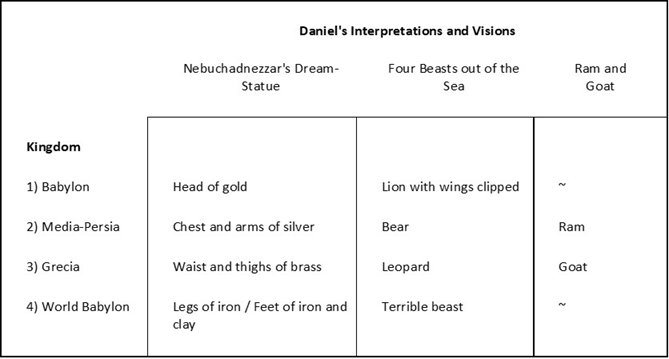
In Part 1, I addressed the meaning of initial Babylon’s head of gold as well as its symbol as a ‘lion’ as described by Daniel. I linked this kingdom (#1) to end times Phases 1 and 2 (see my prior series) that occur largely prior to the Day of the Lord.
Although initial Babylon as a nation is symbolized as a kingdom of wealth in a peacetime environment, it will have its own form of bondage. Certain identified, targeted citizens who do not take secret oaths to a fast-approaching world kingdom alternative that is more overt and visible in plain sight, and instead resist this kind of insidious, behind-the-scenes, silent form of oppression and takeover attempt will have the opportunity to be refined as gold tried by fire. They will be persecuted, consistent with Jesus’ prophetic words. In the last days, this will likely produce an initial remnant who will be “counted worthy” to stand before the Son of man.
In this passage, Part 2, I will address the second kingdom (#2) as identified by Daniel himself as Media-Persia. I will address specific components shown in the table above as these also relate to an ongoing purging process. Following passages will address kingdom #’s 3 and 4.
Media-Persia – Silver Chest and Arms (statue), Bear and Ram
Media and Persia are the tandem kingdom that are identified by Daniel as the one that likely develops alongside the nation of Babylon in the last days. The name ‘Madai’ (Media) itself was given to the son of Noah’s son, Japheth. Japheth’s own name had some meaning within related to ‘expansion,’ ‘to open,’ ‘make roomy,’ etc. The Mede king, Darius, certainly expanded the kingdom when he invaded ancient Babylon. He had a name of Persian origin.
The following Persian king, Cyrus, had meaning in his name that connoted ‘father,’ ‘chief,’ ‘principal,’ etc. A root within the word ‘father’ is also found in several other ancient words, most notably for prophecy purposes including ‘Assyria.’ The interrelation and overlapping of these kingdom names is significant and carries forward through the end times according to scripture. I address some of this later in this passage; that said, identification can be challenging due to the spiritual nature of the kingdom war. The primary point is that these descendent peoples of ancient nations remain highly relevant to our understanding.
Meanwhile, for additional meaning, symbolism associated with visions and interpretations of Daniel shown in the table above that represent the Media-Persia kingdom are still relevant in our current last days time; these include: the chest and arms of the aforementioned statue (Nebuchadnezzar’s dream); an image like a bear; and an image of a ram. These are described separately in three visions interpreted or seen by Daniel. The latter two, the bear and the ram, occurred in the first and third years of king Belshazzar (Nebuchadnezzar’s son) of Babylon, respectively; thus, showing some progression and overlap of the gold-silver kingdoms.
At the top level, all of these symbols and terms, with the exception of ‘chest,’ have direct meaning implying great strength and might. Otherwise, the breast (of silver, described separately below) of this statue carries meaning of ‘beholding,’ ‘seeing,’ ‘prophesying,’ ‘perceiving,’ etc. The term ‘arms’ as appearing on this statue possibly suggests meaning in addition to strength that is associated with an ‘outstretching’ or some kind of assistance offered. Finally, the word ‘bear’ in Daniel’s vision of this creature has additional connotation of ‘moving slowly’ and ‘causing to speak.’ Thus, there is some kind of an outward and influential messaging component either taken on or somehow facilitated by Media-Persia at some point. (I will revisit some of these meanings herein).
In his interpretation of Nebuchadnezzar’s statue dream, Daniel appeared to differentiate this “inferior” Media-Persia kingdom (Dan 2:39) that would succeed initial Babylon’s kingdom (#1) in that it might be slightly more territorial (according to some meaning in this word “inferior”). Regardless, in end times application, great kings and the nation symbolized by creatures like the bear and the ram will wield significant power. The ‘bear’-like king is instructed to “arise and devour much flesh.” Then, as pictured by a ram, Mede-Persian kings are given power to push West, North and South on the earth, to “become great” and do “according to (their/this ram’s) will.” More about the Mede-Persian kingdom as given through each of these symbols is described below.
Silver (chest and arms)
Much additional meaning can be found in the word ‘silver’ as it relates to Media-Persia. We can look to the use of this word in other places in scripture for clues, especially related to how this kingdom corrupts an ‘Israel’ that is deliberately targeted and deceived. To begin, similar to gold, it has obvious meaning related to a store of wealth, value, and means of payment (shekel). Of the metals, it is the one most commonly associated with payment or wealth transfer, albeit many times alongside gold. The worst case, of course, was it being used as blood money (i.e. 30 pieces of silver by Judas to trade out Jesus). Somewhat ironically, the priests declared this silver as not fit to be kept in the temple’s treasury at this time. ‘Silver’ also has deeper meaning in Hebrew related to ‘desire,’ ‘greed,’ or ‘longing’ (for) something.
In the vast amount of patterns in scripture involving Israel in the ongoing kingdom war and its battles with enemies, we see many instances where Israel’s wealth including silver was plundered as a result of God’s judgment. Other times Israel was the beneficiary due to victory in battle and then they plundered their enemies. Alternatively, in their efforts to stave off attacks or form alliances with neighboring kingdoms, we see cases where Israel offered its silver to others. Recipients included common ancient adversaries that are still in play and relevant in the end times. Babylon, Assyria, Syria, and Egypt all received payouts of some kind in agreements. As it relates to intra-‘Israel,’ we see where the ancient northern kingdom took Judah’s silver on at least one occasion.
Silver associated with corruption and idolatry
Otherwise, as is the case with gold, silver becomes a vehicle for corruption and idolatry when viewed and used purely in a worldly sense. The Apostle James prophetically spoke to “rich men” and charged them, “you have heaped treasure together for the last days.” He forecasted that their gold and silver would be “corrupted” and “moth-eaten.” Job prophetically indicated about those who gain silver by unrighteous means, “He may prepare it, but the just shall put it on, and the innocent shall divide the silver” (Job 27:17).
To continue, James also referred to what is likely rich men’s oppression, fraud and cheating perpetrated against servant-workers of the Lord’s vineyard or harvest (James 5:2-4). These are the same ones who kill the vineyard’s husbandmen according to Jesus’ Parable of the Vineyard Workers. Figuratively speaking, the time through our current last days can be seen as a continuation of Solomon’s ancient vineyard that was to be stewarded in return for silver for labor and the fruit thereof (SoS. 8:11). However, in the harvest, not only do the stewards cheat the workers but they cheat on the sales in attempting to sell the “refuse” or chaff of the wheat. (This ties back to the meaning of “greed” within the word silver). Similar to the Prophet Micah who refers to God recognizing Israel’s use of deceit in their balances and weights in the harvest (Mic. 6:11), the Prophet Amos recites about them:
Saying, When will the new moon be gone, that we may sell corn? and the sabbath, that we may set forth wheat, making the ephah small, and the shekel (silver) great, and falsifying the balances by deceit? (Am. 8:5)
God’s Word refers to additional corruption associated with trading in silver. While there was some ancient practice or custom of rightful purchase of others’ labor in ancient times, there is indication of the traffic or sale of people for slave labor at a profit including in these last days. While Israel’s enemies (such as those along the “coasts of Palestine,” those holding the “captivity of Elam,” etc.) engage in this with part of Israel, Israel’s own shepherds are not without blame. Continuing with what James charged against the rich above, he observed the corrupt, “despising the poor.” Continuing from the verse above in Amos, Chapter 8, they say:
That we may buy the poor for silver, and the needy for a pair of shoes… (Am. 8:6)
Finally, along the lines of idolatry, the lady harlot ‘Jerusalem’ in Ezekiel, Chapter 16, is a symbol of last days Israel’s abominations associated with corrupt riches. Among other things, she is “decked with gold and silver.” The ‘northern kingdom’ (i.e. ‘Samaria’) is also prophetically seen for its own idolatry in this same chapter. Otherwise, a good picture of the last days ‘northern kingdom’ is prophesied through the Prophet Hosea who explains the harlot Gomer’s offerings of her riches (including multiplied silver and gold) to Baal; she had been entrusted with these by God. Per God’s request, Hosea, who buys this “adulteress” as a symbol for ‘Israel’ is told, “I will have mercy upon her that had not obtained mercy” (Hos. 2:23). Hosea purchases her for 15 pieces of silver with instructions that she remain loyal to him.
Decimation of Israel’s harvest
Due to corruption and mismanagement by leaders, along with a society whose citizens serve foreign gods of bondage, in much prophetic scripture we see where Israel’s vineyard will become decimated by a scourge and a snare in the last days ‘silver’ phase. Their own shepherds and husbandmen will be implicated. As I showed in Part 2 of my last series, by the end of Phase 3, around the beginning of the Day of the Lord, Israel’s harvest will have been decimated as the “chaff that is driven with the whirlwind out of the floor.” They are prophetically warned about this as follows:
And it shall come to pass in that day, that every place shall be, where there were a thousand vines at a thousand silverlings, it shall even be for briers and thorns. (Is. 7:23)
Thou shalt sow, but thou shalt not reap; thou shalt tread the olives, but thou shalt not anoint thee with oil; and sweet wine, but shalt not drink wine. (Mic. 6:15)
Israel will largely lose its opportunity to bring forth the oil and wine that comes from the initial furnace or lion’s den in Babylon’s golden kingdom. Instead, a corrupt house of Israel in the last days is one that God calls “reprobate silver” or the “dross of silver.” Their seed that was to be holy is cut down to just a stump as described through Isaiah (6:13). As a result, they are referred to as “wine mixed with water.” They will initially be without holy “birthings” (i.e. “without child”) because they will have joined with or became fooled by their adversary that captured them in bondage, blinded them, and rewarded them for iniquities. Last days ‘Ephraim,’ proxy for Israel’s ‘northern kingdom’ within Babylon-U.S., who is under Assyrian “counsel,” “calls to Egypt and goes to Assyria” (Hos. 7:11) all over again. God observes about potential oil of the Holy Spirit in today’s ‘northern kingdom’:
Ephraim feedeth on wind, and followeth after the east wind: he daily increaseth lies and desolation; and they do make a covenant with the Assyrians, and oil is carried into Egypt. (Hos. 12:1)
The culmination of the relationship between the house of Israel and its Egyptian gods within is a key part of the end times ‘silver’ stage.
A revealing and the shame of foreign gods
The house of Israel has been largely committed to ‘Egypt’s kingdom of bondage. This is why we are told, “Ephraim’s sin is hidden” (Hos. 13:12). About these sins that Israel commits under the “shadow of Egypt,” God observes “(they) cover with a covering, but not of my spirit, that they may add sin to sin” (Is. 30:1). ‘Israel’s transgressions are kept under wraps until their collective sin and corruption that they thought would remain whitewashed by their affiliations is exposed in some kind of open revealing. News that will be disclosed appears to be consistent with the meaning of the breast of silver (i.e. ‘seeing,’ ‘perceiving’) and/or meaning of the ‘bear’-like creature described in more detail below that arises and ‘causes to speak.’ At this time of revealing we learn in scripture about their silver and gold, which God calls the “stumblingblock of their iniquity”:
They shall cast their silver in the streets, and their gold shall be removed: their silver and their gold shall not be able to deliver them in the day of the wrath of the Lord… (Ez. 7:19)
For in that day every man shall cast away his idols of silver, and his idols of gold, which your own hands have made unto you for a sin. (Is. 31:7)
In that day a man shall cast his idols of silver, and his idols of gold, which they made each one for himself to worship, to the moles and to the bat. (Is. 2:20)
At the time they become aware and ashamed of their “Egyptian alliance,” the larger house of Israel will have to go through a last days purging, refining and “melting” process for its impurities. While it appears that it will be a Mede-Persian king and his peers who I address below who will be among those who accuse, condemn and point a finger at ‘Israel’ at this time, as did kings and captains in Daniel’s day and beyond, it is merely the same world kingdom of bondage that they serve and adhere to that will have trapped Israel. The only difference is that Israel as the primary target has been made the “fall guy” or scapegoat in the game that is played. Israel will come to understand that their last days position as a scapegoat is as the one already set free into the wilderness (ref: Leviticus, Chapter 16) as a result of the sacrifice of their Messiah, Jesus Christ.
Messengers and warning
For Israel’s awakening, the Lord will have his own messengers. In my passage, End Times Phases of Events Prior to the Day of the Lord, Part 2, I mentioned how appointed watchmen and messengers will arise in Phase 3 at the time of Israel’s purging. Along these lines, one verse in the Proverbs instructs that when dross is taken away from silver, then a vessel for the finer is produced (Prov. 25:4); that is, a “standard.” A last days Elijah-type is referred to as, “And he shall sit as a refiner and purifier of silver: and he shall purify the sons of Levi, and purge them as gold and silver, that they may offer unto the Lord an offering in righteousness” (Mal. 3:3). Messengers like this will be warning with wisdom and instruction about how the Lord’s faithful will need to come out of the corrupt ‘metal’ kingdom system.
This kind of warning will also be signaled by the trumpet (sometimes made of silver in ancient times) such as the one that will be blown by the watchman described by Ezekiel (Chapter 33). He will understand the “sword” that is prophesied to come upon the land. At the time leading up to coming war, the Day of the Lord will be “nigh and at hand” at the sound of the trumpet as described by the Prophet Joel and others:
Blow ye the trumpet in Zion, and sound an alarm in my holy mountain: let all the inhabitants of the land tremble: for the day of the Lord cometh, for it is nigh at hand. (Joel 2:1)
Cry aloud, spare not, lift up thy voice like a trumpet, and shew my people their transgression, and the house of Jacob their sins. (Is. 58:1)
The trumpet that warns of war and the wrath that will come upon the larger house of Israel in the last days will be a final way for them to understand some of the ancient words about being purged and refined as silver that were given to them in God’s Word through their own kings- David and Solomon- such as:
The words of the Lord are pure words: as silver tried in a furnace of earth, purified seven times. (Ps. 12:6)
The law of thy mouth is better unto me than thousands of gold and silver. (Ps. 119:72)
How much better is it to get wisdom than gold! and to get understanding rather to be chosen than silver! (Prov. 16:16)
Receive my instruction, and not silver; and knowledge rather than choice gold. (Prov. 8:10)
A significant part of this wisdom was summarized by the Lord’s ancient servant Job, where he defined wisdom and understanding, acknowledging, “And unto man he said, Behold, the fear of the Lord, that is wisdom; and to depart from evil is understanding” (Job 28:28).
In fact, Job began this same same chapter instructing that there is a way to be refined out of silver and be delivered. He remarked, “Surely there is a vein for the silver, and a place for gold where they fine it” (Job 28:1) Here, “vein” has meaning as an ‘exit’ or ‘going forth.’ Interestingly, there is also root meaning in this word of the ‘rising of the sun,’ possibly suggesting an event coinciding with the rising of the “Sun of righteousness.” I have previously discussed this event on this site including in my last series that coincides with the timing that a remnant of Christ-believers and Israel’s faithful will be delivered just prior to the Day of the Lord.
A remnant is saved
Unfortunately, in the purging process out of last days kingdoms, only a remnant of the Church and Israel will recognize or detect the Lord’s calling and be saved. Many will not heed the warning nor “hearken” to the sound of the trumpet. God warns ‘Israel’ prophetically, “they are gone because of destruction: Egypt shall gather them up, Memphis shall bury them” (Hos. 9:6). Whether or not ‘Israel’ attempts to come out of the ‘silver’ kingdom at the time that they are awakened, it appears that nearly all will experience the following:
As silver is melted in the midst of the furnace, so shall ye be melted in the midst thereof; and ye shall know that I the Lord have poured out my fury upon you. (Ez. 22:22)
In my passage, Phases of Events Prior to the Day of the Lord (Part 2), I described a remnant that will likely come out of this purging process prior to even more severe events in the final seven-year period. It is only through this process that they will understand the nature of the adversary and the sacrifice their Messiah made on their behalf 2,000 years ago. The following refers to a remnant of Israel that will be successfully refined as silver:
And I will bring the third part through the fire, and will refine them as silver is refined, and will try them as gold is tried: they shall call on my name, and I will hear them: I will say, It is my people: and they shall say, The Lord is my God. (Zech. 13:9)
This verse refers to Israel at a time near the end of the age during world Babylon’s final kingdom of iron. Referring to Israel’s remnant at this time, one thing God says that he will do is, “…for iron I will bring silver…” (Is. 60:17). This points to the continuity and overlap of the various last days ‘metal’ kingdoms (#’s 1-4) and the ongoing purging process addressed in this series.
Generally speaking, however, I believe that more severe, escalating events will take place during the course of the last two kingdoms (#’s 3 and 4, Grecia and world Babylon, respectively) in the final seven-year period discussed later in this series, albeit still with an apparent opportunity to be purged out of these of brass and iron, respectively.
Bear
To begin, the term ‘bear,’ like ‘lion,’ discussed in Part 1, holds in its meaning a predator characteristic. This causes it to function as an enemy of Israel up through the end times. Recall that King David fought off actual lions and bears. And he praised how God had delivered him from these. The ‘bear’-like creature representing an adversarial king in Daniel’s vision appears to arise at the time approaching the beginning of the Day of the Lord, a time I mentioned in Part 1 possibly suggested as, “As if a man did flee from a lion, and a bear met him.” Specifically, this bear is described as:
And behold another beast, a second, like to a bear, and it raised up itself on one side, and it had three ribs in the mouth of it between the teeth of it: and they said thus unto it, Arise, devour much flesh. (Dan. 7:5)
This bear raises itself up, meaning that it ‘establishes’ or ‘appoints’ itself. As this may apply to an end times powerful, strong leader, I showed earlier the term ‘bear’ has meaning within such as ‘causing to speak.’ There is some additional meaning in this bear “raising up itself” related to ‘decreeing,’ ‘confirming,’ ‘strengthening,’ or ‘establishing.’ Given all of this, combined with the likely timing near the beginning of the Day of the Lord, this causes one to wonder whether he will initiate or lead some peace agreement similar to that described in Daniel, Chapter 9, or perhaps a preliminary agreement that leads up to it. Meaning related to this covenant is that it will be confirmed and made greater (than a previous one) among many parties involved. It should be noted, however, that there are indications in scripture that the leader who facilitates a final agreement such as this one appears to come from a different kingdom.
An issue-based conflict
Regardless, in the process of this bear raising itself up, we are told that it does so on “one side.” This appears to have significance because it implies some kind of ability to establish ‘togetherness’ or ‘unity’ around a single issue. When considering the entire context and timing involved, this will likely be a geopolitical issue. As we examine this verse above (Dan. 7:5), there may be some additional clues as to the nature of this issue that this leader will leverage.
First, the vision of this bear as given shows that it has three ribs in its mouth. Here, this number may be used with a meaning of literal ‘3,’ or it may have deeper meaning such as one-third or possibly even the number ’13.’ Regardless, we can generally surmise that the issue could be that this king will be able to perceive or detect the coming out or breakaway of a remnant of Israel from a world in bondage at this time. This may be the anointed remnant coming out of the ‘gold’ kingdom phase (i.e. “wedding party” remnant that could include three or perhaps 13 God-ordained or anointed figures among them) and/or the larger remnant that is refined by purging from this current ‘silver’ kingdom (#2).
As it may apply for the holy, royal remnant, there is deeper meaning in the number ‘3’ related to ‘lord,’ ‘prince,’ and ‘captain.’ And the term “ribs” has meaning within such as ‘beam,’ ‘corner,’ ‘chamber,’ ‘plank,’ (within a) ‘door’, etc. These appear to be terms that might suggest a spiritual or symbolic beginning of the Lord’s temple forming in an earthly sense. Here, it should also be noted that the term “ribs” is the same one used in the book of Genesis where God took one of Adam’s ribs for the creation of the woman, Eve. Related to the infant beginnings of the new Kingdom, it could be that a man and woman are joined again as is signaled by the bride and bridegroom figures addressed elsewhere in scripture. This could be the event that leads to an aforementioned declaration of ‘peace’ and ‘unity’ symbolized by the bear. But while this message may be conveyed, the extent to which the public will yet be given the full truth due to the ongoing “vail that is spread over all nations” remains to be seen.
As for the larger remnant of the house of Israel and the number ‘3’ used as it might be related to the proportion, one-third, we know that God will eventually bring Israel back at this time they will be scattered. This is described as, “And I will bring the third part through the fire, and will refine them as sliver is refined, and will try them as gold is tried…” (Zech. 13:9). First, it appears that this Mede-Persian king will take actions (in Phase 3) that will scatter them as I described happens at a time leading up to the Day of the Lord. The term “mouth” as used for the Mede-Persian bear has a meaning of ‘blowing,’ such as to blow away, and furthermore a root within that means ‘scatter into corners.’ God explains through the Prophet Ezekiel (Chapter 5) that this remnant of one-third of Israel will be chased, scattered and followed by the sword. In some ways, this might remind one of the ancient Pharaoh of Egypt who released Israel after the plagues but subsequently decided to pursue them again after three days. Nevertheless, ‘Israel’s scattering while in distress will in some ways be an initial step toward freedom (i.e. released from bondage), yet this event will necessitate the search for their Messiah.
Deliverance for a remnant – a benevolent Persian king?
As either or both remnants of Israel might be related to being in the “mouth” of this Mede-Persian king, ‘bear’-like creature, there is precedent of Persian kings facilitating or expediting the vindication, release or freeing of the people ‘Israel.’ Each in their own way, Kings- Cyrus, Artaxerxes and Ahasuerus- provided a path for them. (Recall that there is some meaning within the arms of the statue meaning ‘assistance’ or ‘outstretching’). In doing so, these kings returned their silver among other things, not to mention items for the temple.
About Cyrus, in particular, I have previously discussed how a ‘Cyrus’-type king’s activities could apply in the end times. This king looks like he provides a release where ‘Jacob’ as a servant is discussed and God promises his redemption (in Isaiah, Chapters 44 and 45). I have previously described ‘Jacob’s remnant’s initial release out of the ‘gold’ kingdom phase. God says that he will break ‘Jacob’s bonds directly, but he makes a strong promise to Cyrus: “I will give thee the treasures of darkness, and hidden riches of secret places, that thou mayest know that I, the Lord, which call thee by thy name, am the God of Israel” (Is. 45:3). Related to an association with “hidden riches,” interestingly some meaning contained in the word ‘Elam’ in addition to it as a proper name and a bloodline includes ‘hidden,’ ‘blind,’ or ‘secret.’
About this time, we are told that, “in the Lord shall all the seed of Israel be justified, and shall glory” (Is. 45:25). Related to the word “seed” here, there is deeper meaning in the word ‘arms’ (such as those on the silver part of the aforementioned statue), a Hebrew word ‘Zera,’ which denotes “seed,” “sowing,” “child,” etc. such as that of a holy remnant being “birthed” for whom this ‘bear’ might provide assistance. (I will explain below how this remnant/“seed” also remains hidden prior to their release).
As ancient king Cyrus did, a last days ‘Cyrus’ may provide a path for an ‘Israel’ remnant on behalf of God. It could be that he functions as an ‘enemy of their enemy.’ Their enemy will have been largely within their home country of ‘Babylon’-U.S. where their “small flock” will have been fodder for cartoon-style propaganda and portrayed in the larger narrative as ‘aliens,’ ‘raiders,’ ‘immigrants,’ etc. They will resist in order to be purged in the ‘gold’ phase. I have surmised that when ‘Jacob’s remnant is initially released from “hard bondage” that they may still remain semi-captive during the ‘silver’ phase as a means for protection due to worsening conditions in the world and in Babylon-U.S. itself.
Other than a benevolent ‘Cyrus’-type, whether ‘blind’ Mede-Persian kings in the last days will fully understand the result of their actions versus them being symbolic as part of the ongoing matrix-game that is played under world Babylon’s direction and tiresome occult narrative is unclear. Meaning within this ‘silver’ kingdom and its Mede-Persian ‘bear’-like king suggests that he will be shrewd and perceptive (part of the meaning in the bear’s “teeth”). Here, it should be kept in mind that while this ‘bear’ appears to be one great and powerful king, there will be multiple kings of Mede-Persia in the progression and overlapping of kingdoms as I will describe with the ram below. This could include both benevolent ones such as a ‘Cyrus’-type as well as those serving the adversary. Of course, this kind of split personality is the case with all kingdoms that are under Satan’s overarching world Babylon kingdom. Because of this, I will show later how the Mede-Persian kingdom’s overall vision will come to an end at the time that the Grecia kingdom arises with its own vision. Divided kingdoms always fall.
The Bear versus Israel
It appears that this Persian king as a ‘bear’-like creature will be a great messenger and orator who reaches and convinces many. The last act of this bear mentioned in the verse above is the charge given to him to “devour much flesh.” Unfortunately, there is a remnant of Israel that God will not spare. While Daniel had this ‘bear’-like creature vision in year 1 of Belshazzar’s waning golden kingdom of Babylon, at the third year of Cyrus he was fasting and mourning three weeks, a period of ‘3.’ This may be equivalent symbolically in timing to the bear’s appointed work in the last days ‘silver’ stage.
If there is any relation of this ‘bear’-like king to the rider on the red horse in Revelation, Chapter 6, who carries an issue-based “sword” (according to the sword’s Greek meaning), then the result of this king’s war will have serious consequences in that peace will be taken from the entire earth and people will kill over it, corroborating the word ‘devour.’ (It should be noted here that the word “kill” in Revelation 6:4 carries meaning within related to ‘confusion’ and ‘panic’).
Otherwise, in addition to this bear’s ‘consuming,’ the word “flesh” carries in its meaning terms like ‘messenger,’ ‘preach,’ ‘publish.’ This is somewhat consistent with the word ‘chest’ (of silver) discussed earlier (‘prophesying,’ ‘perceiving,’ etc.). Both of these words and their meaning could be related to sharing good tidings as I will describe below. However, in perceiving that another spiritual kingdom is forming apart from the world as we know it, it could be this king’s contention that this issue is being concealed and covered up; he may voice this concern publicly.
As this might relate to Israel in particular, the term “flesh” in this verse (Dan. 7:5) also has meaning within related to ‘mankind,’ ‘kin,’ or ‘extended’ kin. So, it is possible that this king’s accusing or blame could come upon Babylon-U.S.’s golden kingdom and the house of Israel within who produce (or are the source of) the holy, anointed remnant of interest. It could be that iniquities that are revealed are related to this remnant’s captivity, persecution, and quieting. A combination of the two issues might justify some kind of war against those who have been their keepers or handlers. At the same time, however, an ‘Israel’ that has pledged to its own adversary and has cooperated in holding their anointed remnant hostage will experience God’s punishment. As for the one-third remnant that escapes, mentioned earlier, scripture says they will be as a “chased roe,” chased by the sword.
Finally, related to the issue of the anointed (“wedding party”) remnant and the meaning for “ribs” that I mentioned above, we should consider that this same word “flesh” (used in the same chapter of Genesis where the word for Adam’s “ribs” is used) is seen in the following verse: “Therefore shall a man leave his father and his mother, and shall cleave unto his wife: and they shall be one flesh” (Gen. 2:24). Jesus later repeated this verse, possibly with prophetic meaning. Perhaps it is not a coincidence that both words, “ribs” and “flesh,” used to describe the bear’s activities at this time may relate to a new kingdom that is forming. Like “ribs,” meaning of the word “flesh” used here in Genesis is the same as that above for that which the bear devours. But this word also carries a meaning of ‘preaching’ or ‘publishing,’ possibly even good tidings. This is very similar to Greek meaning in the word ‘gospel,’ which is the good news of our Lord and Savior. Only through deliverance by faith in Jesus is there some good news in the midst of end times tragedy.
Ram
Daniel had this Ram-Goat vision in the third year of Belshazzar, king of Babylon. In this, Daniel said that he was in Elam, at the palace of Shushan for Persian kings. Meaning contained in the name ‘Shushan’ includes ‘lily,’ ‘white,’ ‘bright ornament,’ and furthermore ‘delight’ and ‘joy.’ Daniel said:
Then I lifted up mine eyes, and saw, and, behold, there stood before the river a ram which had two horns: and the two horns were high; but one was higher than the other, and the higher came up last. (Dan. 8:3)
I mentioned at the beginning of this passage the meaning of the ram here, which includes ‘might’ and ‘strength.’ Daniel clarified in this same chapter that the two horns on this ram represent kings of Media and Persia. The second horn (coming up last) appears to be kings of Persia. Similar to the meaning of Shushan just described, the “horns” describing them have a meaning of ‘hill’ or ‘shining.’ But these also carry somewhat split meaning that includes ‘pushing’ and ‘goring.’ Furthermore, the “long” nature of these horns represents ‘haughtiness’ and ‘pride.’
The Ram’s kings push in several directions
Consistent with meaning implied by the ‘bear’-like creature discussed above, at least one Mede-Persian king may use an issue of controversy, possibly even good news. As for the last days rulers of Persia, Daniel had another vision in the time of Darius the Mede king (a king who became leader over the same chaldeans who “accused the jews” such as Shadrach, Meshach and Abednego and also had princes who accused Daniel). Daniel saw three great Persian kings, albeit with a fourth who would be far richer and become powerful. We are told that with his strength and riches he would stir up “all” against Grecia. Regardless of whether this occurred historically, it may still be a clue for the last days. We know through other scripture in Daniel that there is an end times clash between these two kingdoms. (I discuss Grecia in Part 3).
Before then, we know that in the last days this powerful ram does “according to his wishes.” He pushes and “gores,” Westward, Northward and Southward. None can “stand before him” nor “deliver out of his hands” (Dan. 8:4). As to the significance of these directions, while West, North, and South were commonly used historically as directions in context relative to Israel or the Middle East region, we might consider these in either an expanded or symbolic sense given the last days time period considered as well as for consistency purposes for our holistic understanding of the entire Media-Persia kingdom. (Along these lines, notice that this ram does not push and gore ‘East’- east is commonly symbolically associated with Judah– being the chief tribe east of the temple where the sun rises, which is the primary tribe of Israel’s anointed “small flock” remnant that some kings associated with this ram may at least indirectly support).
Otherwise, it certainly could be that such a king will arise out of a kingdom that is in the current geographic area that was ancient Persia and push outward from there. And he could develop influence and power in an expanded geographic region, even to include parts of adjacent, contiguous continents. But the location where he arises in uncertain. As with other kings represented by the four creatures, he arises out of the “sea” which is a clue. This, combined with the issue-based, spiritual nature of this war means that we must consider deeper meaning in these directions.
To begin, ‘West’ is generally associated with water, particularly the “sea.” In ancient times, meaning within the ‘West’ included the Mediterranean region and its regional sea. In considering the ram more broadly, as one of four beasts out of the sea, ‘West’ (of the Middle East region) is likely a key direction in that the word “sea” can also mean the greater sea that separates continents. I already showed in Part 1 that the first creature, the lion, likely represents ‘Babylon’ as a nation, likely the U.S., which is obviously to the west, across the sea, from the Mediterranean. This would explain potential conflict between the ram and the U.S. regardless of where in the general region the ram arises from.
Next, this ram’s pushing ‘North’ is also significant because it has in its meaning ‘dark’ and ‘hidden.’ And further within is a root meaning to ‘hoard,’ ‘reserve’ or to hold secret or ‘deny.’ This is consistent with this king’s possible attempted uncovering, perceiving, pursuing and pronouncing of a hidden issue as may be done by the ‘bear’-like creature above, such as with regard to a royal Judah remnant held in bondage.
Finally, I have explained on this site that ‘Egypt’ is commonly associated with ‘South’ (of the holy land). The name ‘Egypt’ itself has strong meaning signaling bondage or imprisonment. Yet ‘Egypt’ is an idolatrous system that has been institutionalized in the last days by ‘Babylon,’ which is to the North. Ancient idols and gods of ‘Egypt’ (and others) within have been institutionalized, weaponized, and aided by technology as a matrix system of bondage.
Due to the inextricable relationship between ‘Babylon’-U.S. and the house of Israel, both above board as well as in their hidden, secret game-playing occult worldview, the same spiritual trouble and scourge that ‘Babylon’-U.S. will experience will arrive at the country of Israel’s doorstep. Internal weakening within both ‘Babylon’-U.S. and the country of Israel will precede external forces that invade. In fact, in Jeremiah, Chapter 51, and Isaiah, Chapter 13, there is prophecy of Mede kings coming against and invading last days Babylon. As for the country of Israel, I have previously described that multinational forces will come from the North.
Hidden issue of Israel’s re-“birthing”
Altogether, combined meanings are consistent with the good-news, bad-news “issue” that I described earlier in this passage. That is, an anointed remnant of Israel is likely spiritually “birthed” (i.e. delivered out of the current kingdom) in the gold-silver stage. This signals the coming of a new Kingdom. This is only good news to any true believers. However, the bad news is that Persian kings, possibly including both benevolent and adversarial ones, though perceiving, may not understand the entire picture. Their actions could cause confusion, panic, etc. leading to a large loss of life.
I described earlier that a powerful Persian king may charge of a conspiracy and could be appointed or otherwise try acting on his own in some way to uncover the hidden anointed remnant through his warring. One of the directions that the ram pushes, the West, is associated with the time of sunset. In my writings, I have shown that this appears to be the time period at which an initial anointed remnant escapes into a wilderness setting. This scenario might remind of ancient Pharaoh or King Herod who searched for Israel’s newborn children or infants, the latter king searching for Jesus himself who had to be taken by his parents to be hid.
We know that the end times Son of man/Holy Spirit/’Restrainer’ is removed approximately at the time just prior to the beginning of the ‘silver’ Phase 3. This appears to represent the Lord “hiding his face.” And the ‘Daughter of Zion’ is likely at least related to the “hidden treasure” in Jesus’ Kingdom parable of this same name. She is instructed to “arise” and “cry in the night” at the beginning of watches, and thus, prior to the falling of the walls. She goes to the “field” at this time.
‘Zion’ is also likely lady Wisdom described by King Solomon in the Proverbs who must be sought for wisdom and understanding, (i.e. “If thou seekest her as silver, and searchest for her as for hid treasures…” Prov. 2:4). Yet, at the same time, she is one who must seek for herself. She may be a last days answer to Jesus’ rhetorical question carrying prophetic meaning, “Either what woman having ten pieces of silver, if she lose one piece, doth not light a candle, and sweep the house, and seek diligently till she find it?” (Lk. 15:8). Scripture shows that the ‘Daughter of Zion’ has multiple ‘sons’ in her royal family, yet end times ‘Jacob’ is kept hidden as an arrow in God’s “quiver” (Is. 49:2).
It is possible that around the same time or shortly after the ‘Restrainer’ is removed that, as a “woman in travail,” ‘Zion’ discovers ‘Jacob’ whose “trouble” becomes openly revealed. This is a time described as, “why do I see all men with his hands on their loins…and all faces turn to paleness” (Jer. 30:6-7). This event appears to happen sometime at or near the beginning of Phase 3, which is approximately the beginning of the ‘silver’ phase of purging and the end of the peacetime ‘gold’ phase.
The nature of the nation of Babylon’s siege that includes ‘Jacob’s “trouble” is being taken into bondage by what had previously been an unknown, secret system (“manner of Egypt”) that has been well-organized and engrained under the surface within the so-called Western “free world.” ‘Jacob’ will be delivered out of, or from, his own siege, bondage and persecution. Then, at this time, “Jacob’s trouble” in the ‘silver’ purging phase will come upon the larger house of Israel, Christ-believers, and any others not pledged to Babylon’s emerging kingdom. It appears that Mede-Persian kings may leverage this time to accuse and become more aggressive toward the increasingly chaotic Western world.
This event could signal the “beginning of the end” of Babylon-U.S., manifesting in the division and controversy I alluded to for this kingdom (#1) in Part 1. There is partial meaning within the word ‘head’ (of gold) as it exists in Daniel’s statue interpretation related to “an ability to be seized” (as a body part). I described that in Phase 3 the house of Israel in both the country of Israel and within the U.S. at this time will come under an internal siege that requires refining like silver for believers. Yet, due to today’s last days world Babylon’s system it could be that this siege is controlled and managed by external powers who have silently captured a critical mass of citizens who have made oaths to follow their directions.
The end of Mede-Persian power and a separation of kingdoms
This time may be that which Babylon-U.S. is shown not to be a sovereign land, but instead it could be revealed that it is under the power and influence of modern day European powers, perhaps more specifically, ‘Grecia.’ If Babylon is not sovereign, then it could be their “parent” in Southern Europe who holds, ‘reserves’ or ‘handles’ (an anointed remnant), keeps it secret, and ‘denies’ the public access to (i.e. keeps hidden) the truth about them.
This is the Grecian kingdom about which we are told through Daniel will eventually try to “establish (‘endure,’ ‘continue,’ etc.) the vision” (Dan. 11:14) in the latter days. However, their ‘vision’ is likely a counterfeit and an ongoing occult-based narrative that hides and/or turns the true story of the Lord’s anointed remnant and infant beginnings of his kingdom on earth upside down. Nevertheless, it could be this issue that causes Persia’s ram to “stir up all against the realm of Grecia.” Scripture shows that the powerful Persian kings will initially have a ram’s ability to push and gore in a significant way. However, the ram meets his end suddenly when the kingdom of Grecia (#3) retaliates.
“Broken” horns of the ram at this time certainly indicate an end to its ‘pushing’ or ‘goring,’ but there is also counterintuitive meaning in this word related to “birthing” or “desire,” perhaps coinciding with fulfillment of the horns’ meaning, “hill” and “shining.” This indicates that the Mede-Persian kingdom’s vision via the ram will no longer be the prevailing narrative. Daniel’s fear and falling into a “deep sleep” just prior to the explanation of this vision where the Grecia kingdom defeats the ram coincides with an uncertainty related to the end of this kingdom where “broken” (horns) have meaning related to some kind of ‘crushing’ of a hope and a kind of ‘broken-heartedness.’
A finality here is signaled by the angel Gabriel telling Daniel that the explanation of this vision is the “last end of the indignation” and the “appointed” time of the end. Meaning in the word “end” here infers that a final, infinite separation or “cutting off” will occur. The Lord’s kingdom that will begin as a new kingdom on earth signaled by a “wedding party” remnant may have aforementioned similarities to the first kingdom on earth, starting with Adam and Eve. Interestingly, the term “deep sleep” just referred to that Daniel experienced is the same term that is used when Adam fell into this sleep and a rib was removed for the creation of Eve. The “appointed” time of this vision signals a ‘feast,’ ‘congregation,’ ‘assembly,’ etc.
Daniel had considerable distress throughout his visions as they applied for the very end. He was comforted along the way of his concerns and was finally assured, “But go thou thy way till the end be: for thou shalt rest, and stand in thy lot at the end of the days” (Dan. 12:13). Daniel’s persona here is likely representative of an initial, holy remnant that is delivered.
In the meantime, at this time of separation, there appears to be a pretty clear changeover of prevailing earthly kingdoms. Here, the highly controlled, deceptive narrative at hand will be assumed by a Grecia-world Babylon kingdom (# 3). This is the time at which the angel who tells Daniel that he has come to fight with the prince of Persia will go away (Dan. 10:20). This appears to happen at approximately the time of the beginning of the final seven year period many refer to as the ‘tribulation’ period.
The ‘Assyrian’
Overall, both the story and the nature of the power of Mede-Persian kings in the end times ‘silver’ stage should be considered in light of all prophetic scripture. They are very significant players, yet there is little additional corroborating scripture about these who are referred to in the book of Daniel. One possible link we have for additional insight appears to be a connection with the last days ‘Assyrian’ who has a kingdom that includes “long branches” and a “multitude of waters,” thus signaling many nations and peoples as followers.
I mentioned earlier the common root word within ‘Cyrus’ the Persian as ‘father’ that also applies for ‘Assyria.’ Next, as for ‘Elam’ as a province in Persia, ‘Elam’s name originated as the brother of Asshur (i.e. Assyria). Both of these brothers were sons of Shem, whose own father was Noah. Geographically, both ancient Persia and Assyria began in the same vicinity of original Babylon.
In addition to these bloodline links and historic geographic similarities, the ‘Assyrian’ appears to fit as a strong candidate for being the same figure as one of the powerful Persian kings in Daniel. His story fits not only in terms of specific timing (i.e. much activity leading up to the Day of the Lord in the gold-silver stages) but also in terms of similar circumstances. I will not include great detail here since you can read about the ‘Assyrian’ in my prior passages. In the meantime, the following is a summary list of significant characteristics compared across the two.
| Mede / ‘Persian’ kings | ‘Assyrian’ |
| Bear “raised up” – (“established,” “appointed”) (“they said unto it arise…” – presumably instructions by the four winds of heaven) | Used by God (“rod of my anger”; “I will give him a charge”- Is. 10:5-6) |
| Powerful/great strength (meaning within ‘arms’ of the statue, ‘bear,’ and ‘ram’) | a “whale of the seas,”“camest forth out of his rivers” (Ez. 32:2) “The waters made him great, the deep set him up on high with her rivers running round about his plants…Therefore his height was exalted above all the trees of the field, and his boughs were multiplied, and his branches became long.” (Ez. 31:4-5) |
| Ram pushes/gores West, North, South (Dan. 8:4) | He “troubles the waters”; “fouls the rivers” (Ez. 32:2) |
| Haughty/proud (meaning included in “long” horns of ram) | “For he saith, By the strength of my hand I have done it, and by my wisdom; for I am prudent: and I have removed the bounds of the people, and have robbed their treasures, and I have put down the inhabitants like a valiant man.” (Is. 10:13) |
| Persian king “stirs up” all against Grecia (Dan. 11:2) | “Howbeit he meaneth not so, neither doth his heart think so; but it is in his heart to destroy and cut off nations not a few.” (Is. 10:7) |
| Unconventional war versus Judah royals Last days kings of Elam and Medes among those who “serve themselves” (Jer. 25:25) Enslave the “captivity of Elam” | “…I will cut down the tall cedars thereof, and the choice fir trees thereof…” (Is. 37:24) Part of the coalition (i.e. Asshur) who take “crafty counsel” against the Lord and his anointed (Ps. 83:8) Israel is a scattered sheep; the lions have driven him away: first the king of Assyria hath devoured him (Jacob)… (Jer. 50:17) |
| Greedy (implied by meaning of ‘silver’) | “As my hand hath found the kingdoms of the idols, and whose graven images did excel them of Jerusalem and of Samaria” (Is. 10:10) “And my hand hath found as a nest the riches of the people: and as one gathereth eggs that are left, have I gathered all the earth; and there was none that moved the wing, or opened the mouth, or peeped.” (Is. 10:14) |
| Scatters Israel (meaning within Bear’s “mouth”) At the time the Medes are “stirred up” against ‘Babylon’: “And it shall be as the chased roe, and as a sheep that no man taketh up: they shall every man turn to his own people, and flee every one into his own land.” (Is. 13:14) “Prepare against her the nations with the kings of the Medes, the captains thereof, and all the rulers thereof, and all the land of his dominion. Ye that have escaped the sword, go away, stand not still: remember the Lord afar off, and let Jerusalem come into your mind.” (Jer. 51:28,50) | “Israel is a scattered sheep; the lions have driven him away: first the king of Assyria hath devoured him; and last this Nebuchadrezzar king of Babylon hath broken his bones.” (Jer. 50:17, with end times meaning) “They shall not dwell in the Lord’s land; but Ephraim shall return to Egypt, and they shall eat unclean things in Assyria…My God will cast them away, because they did not hearken unto him: and they shall be wanderers among the nations.” (Hos. 9:3,17) |
| Bear- devours much flesh | “The Lord shall bring upon thee, and upon thy people, and upon thy father’s house, days that have not come, from the day that Ephraim departed from Judah; even the king of Assyria.” (Is. 7:17) “Now therefore, behold, the Lord bringeth up upon them the waters of the river, strong and many, even the king of Assyria, and all his glory: and he shall come up over all his channels, and go over all his banks:” (Is. 8:7) |
| Ram attacked by he-goat (Grecia) (Dan. 8:6-7) “For thus saith the Lord God; The sword of the *king of Babylon shall come upon thee…There is Elam and all her multitude round about her grave, all of them slain, fallen by the sword, which are gone down uncircumcised into the nether parts of the earth, which caused their terror in the land of the living…” (Ez. 32:11,24) *(likely a king of world Babylon) | “And strangers, the terrible of the nations, have cut him off, and have left him: upon the mountains and in all the valleys his branches are fallen, and his boughs are broken by all the rivers of the land; and all the people of the earth are gone down from his shadow, and have left him.” (Ez. 31:12) “For thus saith the Lord God; The sword of the *king of Babylon shall come upon thee…Asshur is there and all her company: his graves are about him: all of them slain, fallen by the sword: Whose graves are set in the sides of the pit, and her company is round about her grave: all of them slain, fallen by the sword, which caused terror in the land of the living.” (Ez. 32:11,22-23) *(likely a king of world Babylon) |
While the last line in the table above shows a similar, rather abrupt end, for both a Mede-Persian king(s) and the ‘Assyrian,’ it is important to note that these kings and their kingdoms will first lose in the unconventional spiritual kingdom war according to the same manner in which they fought referred to above (i.e. “causing terror in the land of the living”). God says that he will set a “fire on the walls” of their cooperating kingdoms. He also promises an “overflowing” of waters that will affect them. Altogether, a fire, walls that are about to fall, and figurative floodwaters of ‘Egypt’ rising show how God will turn the tricks of the adversary against them. These signs are consistent with Phase 3 in my prior series and discussed in my book, Biblical End Times, Volume 1, that describes kings becoming confounded and ultimately upended by their own system of confusion.
All of these signs in this ‘silver’ stage are indicators that the Day of the Lord is at hand. One common additional sign is darkness. In another brief similarity between the ram and the ‘Assyrian,’ recall that one direction the ram pushes is West, an indication of the time of sunset. For the ‘Assyrian,’ in particular, God promises an event that is very similar to those the Prophet Joel describes that include darkness as warning of coming judgment in the Day of the Lord. God says to the ‘Assyrian,’ “And when I shall put thee out, I will cover the heaven, and make the stars thereof dark; I will cover the sun with a cloud, and the moon shall not give her light” (Ez. 32:7).
Here, you might recall the ancient Pharaoh and the three days of darkness prior to God smiting the firstborn of Egypt. There are several connections of the last days ‘Assyrian’ to ‘Egypt’ in scripture. I will not go into detail here, but they represent virtually the same adversary within ‘Israel’s societies that it joins and is captured by as I have mentioned on this site and earlier in this passage.
At this time of the silver kingdom’s darkness in the last days, when the flood pours out, the walls come down, and the forest fire has devoured a large part of the house of Israel, the Day of the Lord will be at hand. At this time, Grecia-world Babylon kingdoms will be staged to arise much more prominently as I indicated above. I explain these kingdoms (#’s 3 and 4), respectively, in my next passage (Part 3).
Grace & Peace,
Lion’s Lair (LL)
(Note: Wherever I refer to the “meaning” or “root” meaning within a word used in scripture, the source for this is Strong’s Concordance, Biblehub.com)

