In Parts 1 and 2 thus far in this series I have described the first two end times kingdom adversaries- initial Babylon and Media-Persia, respectively. In interpretation of these I have reminded that they are interrelated parts of an entire last days world kingdom. This empire is represented by the shiny, bright and great statue that King Nebuchadnezzar envisioned in his dream. Although separate kings and their kingdoms within arise somewhat successively, they still coexist and overlap. That is, until the fourth and final king(dom) that the Prophet Daniel labels “dreadful” and “terrible” destroys them.
In Part 1 of this series I described the importance on a personal level of not succumbing to the soul-destroying bondage of the adversary’s ‘metal’ kingdom and its gods. These are gods Daniel describes as ones that “see not, hear not, and know not” (Dan. 5:23). In these last days, strong faith in the Lord Jesus Christ along with understanding, wisdom and “cunning works” similar to the men of Judah in Daniel’s day will be required in order to separate from these and obtain personal deliverance. Job summed this up simply as, “Behold, the fear of the Lord, that is wisdom; and to depart from evil is understanding” (Job 28:28).
In my last series entitled, Major Phases of End Times Events Prior to the Day of the Lord, I discussed the purging and refining process that any believer will go through in order to be delivered out of the adversary’s kingdom, which will otherwise require one’s strict allegiance and obedience. For those who choose to continue to serve the Lord, the Apostle Paul explained that whatever man attempts to build on the simple foundation that is Jesus Christ, such as gold, silver, precious stones, wood, hay, stubble, that these will be tested by fire at this time when “the day shall declare it.”
All kings and peoples of the earth will finally realize, as King Nebuchadnezzar did in his day, when a faithful remnant is able to escape the earthly kingdom and its figurative fiery furnace of bondage, “there is no other God that can deliver after this sort” (Dan. 3:29); or, as King Darius commented after Daniel emerged from the lion’s den, “He delivereth and rescueth, and he worketh signs and wonders in heaven and in earth” (Dan. 6:27). Daniel’s friends who were placed in the fiery furnace that was heated “seven times hotter” were observed to be alongside one “like the Son of man.” I have described previously that Jesus’ Holy Spirit will be beside believers in the same way in the last days.
God’s Kingdom will ultimately be victorious and set up at last. The last days kingdom of ‘metals’ will be destroyed by the “stone” that is “cut out of the mountain without hands” (Dan. 2:45). At this time, God will set up his own Kingdom, one that “shall never be broken” (Dan. 2:44) and that has Jesus on his throne.
In the meantime, in this passage I will continue to describe the adversary’s kingdoms in the last days as told by the Prophet Daniel. A simple outline of these is given in the following table:
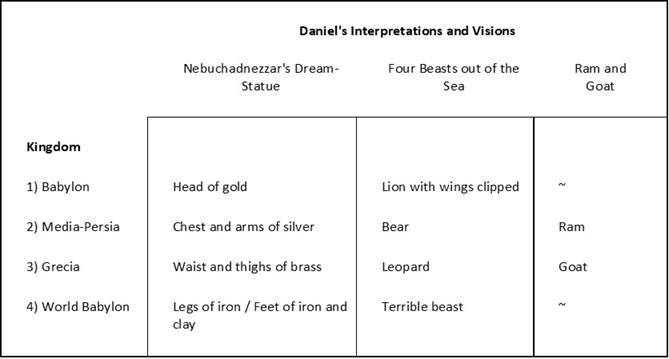
Here in Part 3 of this series I will address kingdom #3. Grecia is represented in Daniel’s visions or interpretations as: brass in the vision of Nebuchadnezzar’s statue; a leopard with wings in Daniel’s vision of the four great beasts; and as a goat in Daniel’s vision of the ‘Ram versus the Goat.’ The latter vision I began describing in Part 2. As I have done in Parts 1 and 2 of this series, below I will attempt to incorporate additional meaning of the Grecia kingdom phase as it may relate to the overall prophetic scenario in the last days.
Generally speaking, major events associated with the Grecia kingdom will take place largely in the first half (42 months) of the final seven years at the end of the age. Since there is much additional detail in scripture about this time period in books other than just Daniel, especially in the book of Revelation, I may address it again in a future passage. But you may also refer to my series on this site entitled, The Day of the Lord. Meanwhile, in this current passage, I will attempt to incorporate major themes that we know will be present during the Grecia kingdom’s earthly dominance, functioning as an adversary aligned against the Lord and his servant-saints.
To begin, some major players in the kingdom war that will emerge more prominently amidst various events include: God himself, of course; Satan as the serpent; and ‘David’ and the ‘house of David.’ And amidst the continuing separation and widening gulf between the Lord’s emerging heavenly Kingdom and Satan’s kingdom, the following distinctions will become apparent in this stage or at its culmination:
- God’s Holy Trinity versus an unholy trinity of spiritual leadership;
- the spiritual development of Jesus’ temple soon to arrive versus the construction of a false earthly temple;
- God’s emerging Kingdom on mount Zion versus earthly “mountains” of power;
- an emerging spiritual kingdom out of the potter’s clay versus an earthly ‘metals’ empire of bondage culminating in iron;
- a remnant that is saved and delivered versus chaff of unbelievers blown away in the harvest; and,
- convergence of believers around the coming of the Lord’s inevitable eternal Kingdom of heavenly peace versus war and destruction due to division of earthly kingdoms.
I will incorporate these themes where they apply in sections below that address this current ‘Grecia’ phase as it exists within Daniel’s framework for last days kingdoms of the adversary.
Grecia – Brass Belly and Thighs (in Nebuchadnezzar’s statue vision)
To begin, like gold and silver discussed previously, brass (or bronze) carries a store of value and provides a means for monetary payment. In Hebrew language, it also represents steel. It is mined out of hills and molten from stone. The land of milk and honey itself, Israel, carries much of it according to scripture.
Additional meaning in brass includes: a ‘ringing’ as a bell (or ‘loud gong’- Greek); a ‘hollowing out’ (as a vessel); to ‘lower’ or ‘let down’; and a ‘gulf,’ ‘chasm,’ or ‘vacancy.’ Brass is also loosely associated in its meaning with ‘serpent’ or its red color such as that found in a hissing serpent’s throat. This correlates with other scripture that suggests a pronounced appearance and activity of “serpents” during this time period.
According to its Greek definition, fine brass has a “brilliant” quality, thus contributing to the “shiny” statue in King Nebuchadnezzar’s vision. This shining can also be observed as it exists as an alloy of copper. I may refer back to some of these meanings as they apply later in this passage.
Contributing Factors for Judgment
Like other metals, if brass is rightly used, it is consecrated to the Lord and employed for the purpose of his Kingdom. For example, it is dedicated to his treasury or is applied for the “things of brass” in his temple. However, as I showed happens in the ‘silver’ Mede-Persian adversary phase, God uses brass more than once to refer to a disobedient Israel (“grievous revolters” and “corrupters”) with expressions such as, “they are brass, tin and iron.” God’s warning to them about their wayward status is that he will, “blow the fire upon it, to melt it; so will I gather you in mine anger and in my fury, and I will leave you there, and melt you” (Ez. 22:20). This is due to their reliance on foreign gods including those of this metal that produce a worldly sense of well-being, wealth and prosperity.
Here, there is consistent meaning in the ‘belly’ portion of brass on Nebuchadnezzar’s statue vision for those of power. Those who have “oppressed and forsaken the poor” are referred to by God’s servant Job as, “Surely he shall not feel quietness in his belly, he shall not save of that which he desired” (Job 20:20). Job also observed that these who have “swallowed down riches” will have them “cast out of their belly” by God (Job 20:15).
In addition to corrupt plundering, we are told that the “hissing” of serpents reflected by their continuous slander and accusations (i.e. “words of the talebearer”) go down into the “inner most parts of the belly” (Prov. 18:8). King David, who was highly in tune and experienced with the spiritual kingdom war, frequently observed about these whose “teeth are speers and arrows” and further stated, “Who whet their tongue like a sword, and bend their bows to shoot their arrows, even bitter words” (Ps. 64:3). Overall, the Apostle Paul summed up these kinds of “enemies of the cross” as those:
Whose end is destruction, whose God is their belly, and whose glory is in their shame, who mind earthly things. (Phil. 3:19)
I have previously described that Babylon’s (and Israel’s within) war against the Lord’s anointed is symbolized by Jeremiah as a proxy for the last days “portion of Jacob” with another “belly” reference saying, “Nebuchadrezzar the king of Babylon hath devoured me, he hath crushed me, he hath made me an empty vessel, he hath swallowed me up like a dragon, he hath filled his belly with my delicates” (Jer. 51:34). God says in this chapter of Jeremiah that the “daughter of Babylon” will become as a threshing floor with a harvest that will come in “yet a little while.” Similar to ‘Israel,’ which God will gather “as the sheaves into the (threshing) floor,” the “virgin daughter of Babylon” at this time is told to “sit in the dust,” “there is no throne,” as well as to “uncover the locks, make bare the leg, uncover the thigh…” (Is. 47:1-3).
In the continuing harvest, there is severe judgment at around the beginning of this ‘brass’ phase. The wall of Zion that falls is an indication of judgment on both ‘Babylon’-U.S. and the country of Israel. Leading up to this, in Part 2 I described a righteous ‘Cyrus’-type Persian king who God promises kingdom blessings and at this point tells him, “I will go before thee, and make the crooked places straight: I will break in pieces the gates of brass, and cut in sunder the bars of iron” (Is. 45:2). This may coincide with the time when those of ‘Israel’ who “bear silver” will be “cut off” (Zeph. 1:16) and when they will be ashamed to the point that they throw their gold and silver in the streets (Ez. 7:19, Is. 2:20).
I have previously described the analogy of a “boiling pot” (with a pot as a common brazen- or brass- vessel) as representing judgment that ‘Israel’ will have to endure. In a verse that observes the “sons of men” as having poison like the “poison of a serpent,” the Psalmist asks for God’s judgment (i.e. to “shoot his arrows”) and prophetically forecasts for their pots, “Before your pots can feel the thorns, he shall take them away as with a whirlwind, both living, and in his wrath” (Ps. 58:9).
There is Hebrew meaning within and association with the word “pot” that includes thorns that ‘spring up.’ Israel’s last days “pot” is also like that symbolized in Elisha’s day that had a “wild vine” inside, causing the sons of the prophets to recognize, “there is death in the pot.” Last days prophetic warnings about such a pot include: Jeremiah’s vision of “a seething pot, and the face thereof is toward the north” (Jer. 1:13); God’s charges against Israel’s rulers who, “eat the flesh of my people, and flay their skin from off them; and they break their bones, and chop them in pieces, as for the pot…” (Mic. 3:1-3); and God’s warning to Israel, “Woe to the bloody city, to the pot whose scum is therein…Then set it empty upon the coals thereof, that the brass of it may be hot, and may burn, and that the filthiness of it may be molten in it, that the scum of it may be consumed” (Ez. 24:6,11).
For those of Israel who are not purged and delivered out of the fire, the result at the beginning of this ‘brass’ phase is that they will be chased out of the land, followed by the “furbished,” “sharpened” (steel) sword. This judgment against at least a part of last days Israel will fulfill God’s ancient prophetic promise to them of “breaking its pride” and making “heaven that is over thy head shall be brass, and the earth that is under thee shall be iron” (Deut. 28:33); or, in having their enemies pursue them, “I will make your heaven as iron, and your earth as brass” (Lev. 26:19). Perhaps this is an indication of them having to deal with the serpent (flying) in the air as well as that which crawls in the dust of the earth.
Spiritual battle
The adversary’s kingdom must either be resisted or fought against by those who have faith. This is shown by example in Old Testament scripture with Jeremiah being set as a “fenced brazen wall” against the adversary within the society of his day. Additionally, it is seen as that of Judah as the Lord’s “bent” bow of steel (or brass) versus its enemies; or like King David’s helmet of bronze for battle. In fact, when considering the commonly referred to ‘armor of God’ (Ephesians, Chapter 6) many of these pieces (i.e. helmet, shield, breastplate, sword, etc.) were commonly made of brass. In several cases, these are linked to David or those of the house of David.
At least part of the Lord’s army in the last days spiritual kingdom war is symbolically represented by chariots with horses such as those that scripture in Zechariah (Chapter 6) indicates are assisted by the four spirits of heaven that come out of “mountains of brass.” I have shown that the Lord’s anointed (‘Jacob’-Judah) remnant of earthly servants, though delivered early, remain as a fighting force and as the epicenter in this supernatural kingdom war. The ‘Daughter of Zion’ is told, “for I will make thine horn iron, and I will make thy hoofs brass: and thou shalt beat in pieces many people…” (Mic. 4:13). In a section of Isaiah that speaks of the end times, it is possible that ‘Jacob’ or a similar servant is the one who is referred to as carrying a sword and bow as follows: “Who raised up the righteous man from the east, called him to his foot, gave the nations before him, and made him rule over kings? he gave them as the dust to his sword, and as driven stubble to his bow” (Is. 41:2).
Those in Judah and Ephraim who are part of the ‘Jacob army’ that I have discussed previously on this site are figuratively referred to in this spiritual war of chariots, horses, swords, bows and arrows as, “When I have bent Judah for me, filled the bow with Ephraim, and raised up thy sons, O Zion, against thy sons, O Greece, and made thee as the sword of a mighty man” (Zech. 9:13). Due to the nature of the adversary, it will be necessary for this anointed remnant to have supernatural power similar to that Jesus gave to his disciples in his day; that is, “power to tread on serpents and scorpions, and over all the power of the enemy: and nothing shall by any means hurt you” (Lk. 10:19). I will discuss last days serpents in more detail below.
Of course, the Lord himself is indicated in this battle at a time that he says he will take vengeance on his enemies. We are told in more than one place in scripture that he will destroy the “horses and their riders,” which is certainly applicable to this time period given the first four seals that are opened as described in the book of Revelation. In this battle, we are told that the Lord “maketh a way in the sea, and a path in the mighty waters” and furthermore:
Which bringeth forth the chariot and horse, the army and the power; they shall lie down together, they shall not rise: they are extinct, they are quenched as tow. (Is. 43:17)
Following the verse earlier about the army of Judah-with an Ephraim head covering- we are told that the Lord will “defend them” and, “the Lord shall be seen over them, and his arrow shall go forth as the lightning: and the Lord God shall blow the trumpet, and shall go with whirlwinds of the south” (Zech. 9:14). Of course, we are told that the Lord, battling against his adversary, “hath his way in the whirlwind and in the storm, and the clouds are the dust of his feet” (Nah. 1:3).
Perhaps related to this bow and arrow scenario with God defending Judah, we are told through King David, “But God shall shoot at them with an arrow; suddenly shall they be wounded” (Ps. 64:7). A deeper meaning of ‘arrow’ or an archer is to ‘divide’ or ‘cut in two,’ thus leading the enemy to destroy itself in the last days. Recall Jesus’ words about this and how he came to divide in this manner. The following are associated with his spiritual fighting in this ‘brass’ time period at the end of the age (including him as the “good news of peace on the feet” for believers) coinciding with the first part of the final seven years:
For he put on righteousness as a breastplate, and an helmet of salvation upon his head; and he put on the garments of vengeance for clothing, and was clad with zeal as a cloak. (Is. 59:17)
And his feet like unto fine brass, as if they burned in a furnace; and his voice as the sound of many waters. (Rev. 1:15)
And unto the angel of the church in Thyatira write; These things saith the Son of God, who hath his eyes like unto a flame of fire, and his feet are like fine brass. (Rev. 2:18)
So this ‘brass’ phase of the ‘Grecia’ kingdom has strong indications of war. Historically, Israel’s enemies also commonly fought with chariots of iron, horses, bows of steel, etc. Goliath the Philistine who symbolically represented a timeless enemy of Israel had a helmet of brass, a “target” of brass between his shoulders, a javelin of steel, shin pieces of brass, etc. I will describe the Grecia kingdom’s warring in more detail later in this passage.
Spiritual battle- the serpent
In the meantime, the more prominently pronounced serpent observed in various parts of scripture at this stage suggests that we might consider the unconventional, spiritual side of the kingdom war in more depth. The culmination of this phase is at the midpoint of the final seven year period when the “great dragon,” “that old serpent,” is cast out of heaven and down to earth. In the meantime, in this phase where the dust and ashes of the wall that falls (mentioned above) remain, the serpent will, figuratively speaking, continue to crawl on its belly in the dust as was designated by God from the beginning in the Garden. Speaking of, just as the serpent in the Garden, as the meaning of the word “serpent” suggests, he remains ‘crafty,’ ‘subtle,’ and ‘smooth.’ His “cunning” nature, in a bad way as opposed to the wise way that it takes to escape the adversary’s kingdom, is behind leaders’ gathering and taking “crafty counsel” against the Lord and his anointed in the last days (ref. Psalm 83). Recall that Jesus instructed about the last days, “Take heed that no man deceive you” (Matt. 24:4).
However, as I describe in detail in my book, Biblical End Times, Volume 1, the time will come when the Lord will turn the adversary’s devices against itself. This is seen from ancient times by Aaron’s rod becoming a serpent, then swallowing up the wise men’s and sorcerer’s own rods that became serpents. Shortly thereafter, in the wilderness Israel did not help themselves by complaining about their lack of bread and water along with the “light bread” their souls “loathed.” The Lord sent “fiery” serpents that bit them in judgment. God then told Moses to make a serpent and put it on a pole. Moses made one out of brass. Anyone in the camp who was bitten could then look upon this pole, be healed and live.
The last days ‘brass’ kingdom time period will be similar. Israel will have among them: those whose “poison is like the poison of a serpent” (Ps. 58:4); those who have sharpened their tongues like serpents (Ps. 140:3); those who have turned to worship or burn incense to the brazen serpent like the one Moses made (2 Ki. 18:4); and Pharisee-types whom Jesus called serpents and a “generation of vipers” who had lying, hypocritical tongues. As a result of their practices, the Lord will give them exactly that which they worship (i.e. “The burden of the beasts of the south: into the land of trouble and anguish, from whence come the young and old lion, the viper and fiery flying serpent”- Is. 30:6).
This is the time indicated in this same chapter (30) of Isaiah when the “wall” will fall, “whose breaking cometh suddenly at an instant.” In an earlier chapter describing Israel’s destruction where God says “thy speech shall be low out of the dust” and “shall whisper out of the dust,” he says, “Moreover the multitude of thy strangers shall be like small dust, and the multitude of the terrible ones shall be as chaff that passeth away: yea, it shall be at an instant suddenly” (Is. 29:5). This will be at the time God lays the “lofty city” low and “brings it to the dust.” He says about this time through Isaiah, “And the fortress of the high fort of thy walls shall he bring down, lay low, and bring to the ground, even to the dust” (Is. 25:12).
These verses that speak of a “sudden” calamity likely indicate the beginning of this brass kingdom phase at the end of the age, a time when Israel’s corrupt leaders will run and hide at the time of destruction. God says that he will send the serpent:
And though they hide themselves in the top of Carmel, I will search and take them out thence; and though they be hid from my sight in the bottom of the sea, thence will I command the serpent, and he shall bite them. (Am. 9:3)
But others who rebel in addition to Israel will also experience serpent-related judgments. In addition to the dragon that comes to earth as described in Revelation, Chapter 12, the Lord warns the region of Palestina about the same flying serpent referenced above, “for out of the serpent’s root shall come forth a cockatrice, and his fruit shall be a fiery flying serpent” (Is. 14:29).
Job spoke about leviathan, as did King David and the Prophet Isaiah, which comes from the sea. (See meaning of “sea” with connotations of the Mediterranean-Grecia region discussed later in this passage). He expressed dismay as to an ability to overcome this monster serpent. Among other things related to this kingdom war, Job recognized, “He esteemeth iron as straw, and brass as rotten wood. The arrow cannot make him flee: slingstones are turned with him into stubble” (Job 41:27-28). However, we are assured, “In that day the Lord with his sore and great and strong sword shall punish leviathan the piercing serpent, even leviathan that crooked serpent; and he shall slay the dragon that is in the sea” (Is. 27:1).
Deliverance for a remnant
In this phase, those who have not been delivered out of earlier end times phases will have a chance to be part of an ongoing purging, harvest and deliverance process. Those who awaken and seek to be purged out of the adversary’s empire of bondage and “fetters” (or shackles) of brass in this phase are indicated by God saying that he will take brass from wood and gold from brass (Is. 60:17). As their bondage relates to Grecia specifically we learn, “The children also of Judah and the children of Jerusalem have ye (Tyre, Zidon, “coasts of Palestine”) sold unto the Grecians, that ye might remove them far from their border” (Joel 3:6).
Recall Nebuchadnezzar’s vision of a kingdom tree that was cut down to a stump where ‘bands’ (meaning ‘imprisonment’ or ‘bonds’) of gold and brass were left on it upon the command of a watcher and a holy one “coming down from heaven.” His Gentile kingdom was not only representative for a remnant of Israel but also applicable to Gentile believers and their kings who will have to be purged out of or freed/released from the ‘metals’ kingdom that will ultimately be destroyed. ‘Bands’ here also has a root meaning within that includes to ‘make ready,’ ‘hold,’ and ‘keep.’ I mentioned previously in this series that this could be related to the “hidden” issue or secret of a remnant held within that causes conflict among various kingdoms including last days Media-Persia (see Part 2). I have also surmised that this issue is one that the kingdom of Grecia in this current phase could very well be involved with.
Deliverance for a remnant- Garments and anointing
Garments frequently mentioned in scripture come into play in this ‘brass’ phase, consistent with meaning of covering for the middle section of the body (belly, thighs, loins, etc.). In order to be purged out of the adversary’s kingdom, Jesus instructed that we should be found wearing white “raiment” (or garments) in the last days. We are to “keep our garments” and “not defile” them. Similarly, Moses instructed the people ‘Israel’ to wash their garments prior to God coming down to Mount Sinai. Jacob in ancient times instructed his household to change their garments upon entering the holy land. This represented a departure from foreign gods.
Jacob, who as a boy was given Esau’s “goodly raiment” from his mother, later in his “ladder” dream was promised that his seed would be as the “dust of the earth” and will again be brought “into the land.” He also observed in this dream, “this is none other than the house of God,” and that, “this is the gate of heaven.” An end times ‘Jacob,’ who I have previously described as likely the one who “breaks iron from the north,” will see this vision come to fruition. At least a part of the saints seen prepared for the heavenly Kingdom in the book of Revelation include the martyrs who are described in the fifth seal clothed in white robes. Then, after the sealed 144,000 of Israel, a multitude from among all nations and peoples is also seen wearing white robes.
There are several different meanings of garment or raiment as it is used in scripture. One meaning is a ‘hiding,’ or making one ‘blind,’ of his nakedness. This is consistent with how the word for clothing is used in the book of Revelation (i.e. that the “shame of thy nakedness not be seen”). For the wicked who “pull off the robes with the garment” of the innocent (Mic. 2:8), we are told that their own garments cover “violence” (Mal. 2:16). Perhaps an alternative picture for end times saints is seen in God’s ancient instructions for Aaron’s and his sons’ priestly and holy garments:
And thou shalt put them upon Aaron thy brother, and his sons with him; and shalt anoint them, and consecrate them, and sanctify them, that they may minister unto me in the priest’s office. And thou shalt make them linen breeches to cover their nakedness; from the loins even unto the thighs they shall reach. (Ex. 28:41-42)
As we see with the house of Aaron, the placing of garments or the “girding up” of the loins (i.e. to ‘appoint,’ ‘restrain,’ etc.) are in some cases associated with anointing. In ancient days, placing the hand under the thigh was done as part of making a covenant or oath in some cases. Otherwise, related to anointing, to the wise and “living” King Solomon instructed, “Let thy garments be always white; and let thy head lack no ointment” (Eccl. 9:8). Aaron’s anointing on his head went down to the “skirts of his garments” (Ps. 133:2).
More than once the Prophet Daniel reminded that the saints will “possess” the Kingdom. King Solomon recalled God’s promises to ‘Zion,’ likely applying for Israel’s Queen-Mother figure. The ‘Daughter of Zion’ is likely at least a ‘type’ of the woman who “girds her loins with strength, and strengthens her arms,” “all her household are clothed with scarlet” and “strength and honor are her clothing” (Prov. 31:17,21,25). About her and her anointed remnant, God says in his Word:
To appoint unto them that mourn in Zion, to give unto them beauty for ashes, the oil of joy for mourning, the garment of praise for the spirit of heaviness; that they might be called trees of righteousness, the planting of the Lord, that he might be glorified. (Is. 61:3)
I will abundantly bless her provision: I will satisfy her poor with bread. I will also clothe her priests with salvation: and her saints shall shout aloud for joy. There will I make the horn of David to bud: I have ordained a lamp for mine anointed. (Ps. 132:15-17)
Job told us that the Lord “girds the loins” of kings (such as David) with a girdle (Job 12:18) and that he “prepares raiment as the clay” (Job 27:16). Elisha’s loins were girded when he anointed a king of Israel. But scripture tells us that the Lord also loosens kings’ loins and brings them down as well. As for the garments of the Lord himself, we are told that: these are washed in wine (Gen. 49:11), he has “bound the waters in a garment” (Prov. 30:4), he “coverest (him)self with light as with a garment” (Ps. 104:2) and they are as “white as snow” (Dan. 7:9). Recall that those who merely touched Jesus’ garments were healed and “made whole.”
Sackcloth for a mourning remnant
On the other hand, girded sackcloth on the loins is observed related to last days punishment on ‘Israel.’ One of the most well-known examples is the Two Witnesses whose activities apply to this ‘brass’ kingdom time period. The Prophet Isaiah describes loins “filled with pain” (as a woman who travails) at the time of the nation of Babylon’s last days fall, an event I indicated above that will at least roughly coincide with that of the country of Israel’s downfall. This is at or near the beginning of the Day of the Lord when ‘Israel’ will suddenly be in collective mourning and repenting in sackcloth and ashes.
This day of his judgment is foreshadowed by ‘Jerusalem’s lamentations through the Prophet Jeremiah, prophesying, “thou wilt bring the day that thou hast called.” This will be the day described in Jeremiah’s Lamentations when the Lord wipes out Zion and the house of Jacob at the hands of the Gentiles, thereby causing the “elders of the Daughter of Zion to sit upon the ground, and keep silence: they have cast up dust upon their heads; they have girded themselves with sackcloth: the virgins of Jerusalem hang down their heads to the ground” (Lam. 2:10). In addition to sackcloth here, another indication of this ‘brass’ phase includes references Jeremiah makes about the middle section of his body such as, “my bowels are troubled” and “my liver is poured upon the earth.”
In ‘Israel’s punishment, as they are starved for hearing the truth of the Lord’s Word, this will likely be the time at which John the Revelator will read the scroll that is “sweet” to the tongue but makes the “belly bitter.” This is also likely represented by God instructing the Son of Man through Ezekiel to cause his “belly to eat, and fill thy bowels” with the words of this scroll so that he can go speak these to the house of Israel. At this time, he says, “Upon the land of my people shall come up thorns and briers; yea, upon all the houses of joy in the joyous city.” Here, he refers to them wearing sackcloth:
Tremble, ye women that are at ease; be troubled, ye careless ones: strip you, and make you bare, and gird sackcloth upon your loins. (Is. 32:11)
And I will turn your feasts into mourning, and all your songs into lamentation; and I will bring up sackcloth upon all loins, and baldness upon every head; and I will make it as the mourning of an only son, and the end thereof as a bitter day. (Am. 8:10)
I have previously discussed the significance of last days travails and “birthings,” signs of the ‘belly’ or ‘womb,’ which signal pending calamities and walls falling to become as dust. In Part 2 of this series, I described the divide and separation that will occur at the transition of the ‘silver’ kingdom to the ‘brass’ kingdom. God tells the Son of man who is represented through the Prophet Ezekiel to “sigh” with the “breaking of thy loins” before the house of Israel in the last days. “Breaking” here has a meaning of ‘crushing’ or ‘destroying.’ In this time of divergence and separation of kingdoms, related to garments, one might be reminded of Jesus’ words about how a new cloth cannot be put onto an old garment. This may also remind one of God’s instructions for Israel, “Thou shalt not wear a garment of divers sorts, as of woollen and linen together” (Deut. 22:11).
Yet there will be a deliverance for some. Additional meaning in the word “breaking” includes ‘hope,’ ‘viewing’ and ‘tarrying.’ In other words, referring to those who wait with hope. About girding our loins, applicable for the last days, we are instructed by the Apostle Peter, “Wherefore gird up the loins of your mind, be sober, and hope to the end for the grace that is to be brought unto you at the revelation of Jesus Christ” (1 Pet. 1:13). “Let your loins be girded” and your “lights burning” are also instructions for when the Lord returns from the wedding (Lk. 12:35). This is another event I described previously as likely happening at the time of transition to this brass kingdom at the end of the ‘silver’ phase where Job’s words, “God heeps up silver as the dust” (Job 27:16) possibly apply. As for ‘bringing to birth,’ God refers to the last days remnant of Israel who are delivered as those who are “borne by me from the belly.”
Spiritual formation of the Lord’s temple
In addition to the ‘metal’ kingdoms, there is heightened indication or incidence during this phase of wood, stone and other building materials. As with the metals, these are either used in a good way (i.e. consecrated to the Lord) such as by King David and his son Solomon who accumulated much of this, or otherwise in a vain, worldly way. Possibly symbolizing the adversary that attempts to bring about their counterfeit kingdom and temple supporting their earthly empire, God warns, “Woe unto him that saith to the wood, Awake; to the dumb stone, Arise, it shall teach!” (Hab. 2:19).
The Lord’s spiritual temple will begin forming in this brass phase of the last days. We see how brass was used in ancient times when Israel constructed their tabernacle in the wilderness. Then, later, after David accumulated “brass in abundance without weight,” King Solomon used brass for the temple. Pillars and posts were of brass. Brass was also used for doors of the “court of the priests,” the “great court,” etc. On the outside, gates were commonly of brass.
Much furniture and vessels for the temple were also made from brass. Somewhat interestingly, “cunning” works of brass for Solomon’s temple mentioned were done by those of the ‘northern kingdom.’ One of these men was of the tribe of Naphtali and we are told was “filled with wisdom and understanding.” Another from the tribe of Dan was “skillful” to work and engrave in gold, silver, brass and other materials and to “find out every device which shall be put to him” (2 Chron. 2:14).
Formation of the Lord’s temple along with his wise servants in the last days is symbolic, of a spiritual nature, and will develop behind-the-scenes while the adversary continues “construction” of their own counterfeit empire. Perhaps this quiet, spiritual building of the temple was foreshadowed in Solomon’s day during which the house of the Lord was, “…when it was in building, was built of stone made ready before it was brought thither: so that there was neither hammer nor axe nor any tool of iron heard in the house, while it was in building” (1 Ki. 6:7).
Somewhat similar, an altar of 12 whole stones in both Moses’ and Joshua’s ancient day built for offerings was described as one which “thou shalt not lift up any iron tool upon them.” In Jacob’s ancient day “ladder” dream that I described above, he set a stone that he had used as a pillow in Bethel (meaning ‘build, ’‘set up,’ ‘house of God,’), poured oil on it and made a vow:
If God will be with me, and will keep me in this way that I go, and will give me bread to eat, and raiment to put on, So that I come again to my father’s house in peace; then shall the Lord be my God: And this stone, which I have set for a pillar, shall be God’s house: and of all that thou shalt give me I will surely give the tenth unto thee. (Gen. 28:20-22)
Infant re-beginnings of the Lord’s Kingdom temple are observed during this end times ‘brass’ phase. God’s Word refers to at least one servant who measures for this eventuality. We are told about a man with an “appearance of brass” who has a flax line and measuring reed for this (Ezekiel, Chapter 30). This beginning of planning for the temple is also seen, not surprisingly, in instructions given to John the Revelator who is told by an angel not to measure the courts being trampled, but to, “Rise, and measure the temple of God, and the altar, and them that worship therein” (Rev. 11:1). In anticipating Jesus the vine, King of Kings, a last days servant who is the “branch” (a last days ‘David’) will eventually “grow up out of his place” and build the Lord’s temple along with those who come from “far off” (Zechariah, Chapter 6).
Grecia – A Leopard with Four Wings and Four Heads
Referring to one of his visions applying for the last days, the Prophet Daniel said, “And four great beasts came up from the sea, diverse one from another” (Dan. 7:3). All four of these creatures he described were ‘great,’ generally meaning very large in stature. This term corroborates Daniel’s later interpretation in the same chapter that these are kings (or as ‘chiefs’ or captains’). This meaning may also imply that they have the ability to ‘increase’ or ‘multiply’ (in terms of a kingdom).
Yet for the four creatures’ general similarities, the verse above shows that they are still distinct. And while I have described in this series that their kingdoms overlap and that each of these kings continues beyond the arrival of the following king(dom), there is a succession seen. As the bear succeeds the lion, the Grecia kingdom’s leopard succeeds the bear. This is apparent from the ‘Ram versus the Goat’ vision that I will discuss below, but possibly also foreshadowed by the angel telling Daniel’s captive persona that, after he fights with the Prince of Persia and departs, then the Prince of Grecia will come.
We are generally familiar with the geographic area of Grecia in ancient biblical times. In our current end times period, ‘Grecia’ in bible prophecy can still generally be considered as southern Europe as it exists in the midst of the Mediterranean region. I explained earlier in this series the meaning of Daniel’s vision of four beasts or creatures rising, “out of the sea,” where “sea” has a primary meaning that causes us to consider the Mediterranean Sea (region) first. This would appear to apply for the Grecia kingdom’s last days ruler, at least in an earthly sense. Geographically, this area was considered as the ‘north’ (vis-a-vis Israel) in ancient days. I have previously shown that meaning within the word “north” includes inferences such as ‘hidden,’ ‘secret,’ etc.
Possibly related, I have referred to an anointed “small flock” remnant which is at the epicenter of the last days spiritual kingdom war. These are likely the “oil” and “wine” that God instructs the rider on the black horse in Revelation Chapter 6 not to hurt at the time of harvest threshing. Somewhat interestingly, other than proper name associations, part of the meaning of the word ‘grecia’ includes ‘wine’ or ‘effervescing.’ And a part of the meaning of ‘leopard’ is to ‘filtrate’ (as causing a slow drip). Perhaps these meanings combined relate to Israel’s remnant that continues to spiritually form and separate from the ‘metals’ kingdom of bondage while they are in circumstances I have described as being ‘held,’ contained or possibly detained (according to the previous meaning of the word ‘bands’).
The Leopard-like creature
It is possible that the leopard-like creature here, figuratively speaking, has stripes or spots that blend in to a last days ruling kingdoms scenario. It is also possible that these rulers cooperate and craftily scheme behind the scenes, in a camouflaged manner. Earlier in this passage, I pointed to the kind of deception that will be part of this ‘brass’ time period where the cunning serpent spirit arises more prominently. One general principle given about a leopard in scripture is that it cannot change its spots (Jer. 13:23). This is found in a part of God’s Word where he observes that those who are accustomed to doing evil continue to do so.
In this current series, I have surmised that the primary issue at hand is dealing with the manifestation of the Holy Spirit alongside the oppression and persecution of an anointed “small flock” remnant of Israel who have been “sold unto the Grecians.” As I just indicated above, they may be a part of the “secret” issue along with its “hidden” nature. This is not to mention the attempt to keep quiet the overriding issue which is the soon return of the Lord Jesus Christ and the coming of his Kingdom.
In the meantime, to consider the adversary’s dominant kingdom in this phase in more detail, it makes sense to use the relatively short description of the king(dom) ‘Greece’ given by Daniel as the third of four creatures or “beasts” that come up out of the sea:
After this I beheld, and lo another, like a leopard, which had upon the back of it four wings of a fowl; the beast had also four heads; and dominion was given to it. (Dan. 7:6)
As with the ‘silver’ Media-Persia kingdom, there is one particular powerful ruler who is the first indicated among others in the Grecia kingdom. Meaning within the term ‘wings’ of this leopard-like creature here includes ‘highest places’ or ‘himself.’ So, this appears to imply a great ruler who stands alone. More obvious meaning, yet difficult to conceive, is “wings of a fowl” implies an ability to fly.
This additional meaning of “wings” causes more consideration of spiritual and supernatural factors, not to mention the nature of the “flying serpent” that I alluded to earlier in this passage. Here, wings for flying may include some meaning such as an ability to ‘flee’ or ‘go away,’ or to otherwise ‘shine forth’ and be ‘strong.’ Those who are familiar with the nature of the spiritual kingdom adversary understand the dualism or balance-of-opposites approach that he employs. In this phase such a deceiving, fear-mongering ruler may present a half “fierce, doom-and-gloom” approach alternating with a half “sunny and bright” kind of reassurance.
Finally, this leopard-like creature not only has four wings but also four heads. Consistent with the picture of a powerful king above, the term ‘head’ has in its meaning connotations one might suspect (i.e. ‘chief,’ ‘ruler,’ etc.). Indeed, we are told that “dominion” will be given to this king with meaning of an ‘empire,’ ‘domination,’ and to ‘rule.’ Keep in mind that this time period is that of the opening of the seals revealing the horses and their riders in Revelation, Chapter 6. More than one of these are appointed or given great power. This may be at least one clue that one or more of the four creatures given power like the leopard as described here in the “sealed” book of Daniel could be the “riders” who appear at the unsealing of parts of the scroll in the book of Revelation.
There is certainly also meaning in the number ‘4’ found in this leopard’s four wings and four heads. In the ‘Ram versus the Goat’ scenario that I will describe next, this goat of Grecia has four “notable” horns that arise after its primary horn, its first king, is broken. Other than this possible relation, the meaning of ‘four’ is unclear; albeit, it may possibly apply to geographic coverage for rule over part of the earth in which this kingdom spreads its wings, so to speak, or where its ‘heads’ have meaning related to a ‘band’ or ‘company’ (i.e. other cooperating leaders). This meaning would be consistent with the “great” nature of this beast that has an expanding or ‘increasing’ quality such as that which I described at the beginning of this section. It would also be consistent with the rider on the pale horse at the opening of the fourth seal that is given power over a “fourth part” (a meaning within the number ‘4’) of the earth. This number also has a meaning of ‘completeness’ in the Greek, which could suggest a complete coverage of the earth’s landmass (and its people), which is approximately one-quarter of the earth. This is consistent with the Grecia kingdom as a goat covering the entire earth at this time as I discuss below.
‘Ram versus Goat’ vision
In Part 2, I explained a little of Daniel’s ‘Ram versus the Goat’ vision from the standpoint of how the ram’s mission is ended by the goat that destroys it. Here, I will explain more about the he-goat, which Daniel tells us represents the kingdom of Grecia (Dan. 8:21).
According to Daniel, the he-goat charges at the ram from the west. I have explained before in this series that the meaning of “west” includes ‘sea,’ which again infers the Mediterranean Sea in its meaning. This sea remains directly due west of the Media-Persia region. Movement of the goat to the east is toward the sun’s rising. This is symbolically consistent with the Sun of Righteousness rising with “healing in his wings” as I indicated in my passage, Major Phases of End Times Events Prior to the Day of the Lord, Part 2. He appears to do this at or around the time of this transition from the ‘silver’ to this current ‘brass’ phase.
While these directions are helpful, an important consideration is that this goat, “touched not the ground,” in Daniel’s vision. As a result of the process by which the goat will defeat the ram, the latter we are told will be “cast down to the ground,” meaning to ‘earth’ or to the ‘nations.’ This points to supernatural- and spiritual-related events surrounding the ram and the goat in Daniel’s vision that may limit our understanding as to how the transition between their kingdoms will play out. That is, the extent to which events surrounding this event and others will be readily identifiable and observe-able.
Related to the spiritual nature of Grecia’s kingdom, the goat is described by Daniel as “rough” or “shaggy.” Meaning within these terms includes ‘devil.’ Additional meaning includes ‘whirlwind’ (that I referred to earlier), which is a term used several times across scripture applying to the spiritual realm of this time period. As it applies here, the goat appears to come as a (‘tempestuous’) ‘storm’ along with great ‘fear.’ He comes with great power and with “fury” while in a “rage.” His “running into this ram” means to ‘divide speedily.’ One interesting piece of the meaning of “rage” here is ‘drop’ or ‘distillation.’ This is especially interesting when considering aforementioned ‘wine’-related meaning within the words ‘greece’ and ‘leopard.’
I described in Part 2 how the ram (or Mede-Persian kingdom) may be responsible for some kind of early, albeit slow, release of wine or oil that represents the “small flock” remnant, which I have described prior is at the epicenter of the last days spiritual kingdom war. In the spiritual realm, in which Daniel witnessed, “the four winds of the heaven strove upon the great sea,” the four great “beasts” raised up include both the Persian bear and the leopard of Greece (discussed above). These personas as rulers arise to do their appointed work according to supernatural forces. According to meaning within the word “beast” that applies to both, they may be ordained for a ‘repairing,’ ‘restoring,’ or a ‘keeping alive’ component. It is possible, however, that the king of Grecia has a different understanding and vision and may not like the Mede-Persian’s attempts at restoration.
Additional insight into the he goat of Grecia is that there is a “notable horn” between his eyes. According to Daniel, this horn is this kingdom’s first king. “Notable” carries a meaning of ‘vision,’ ‘prophecy,’ and ‘agreement.’ This generally corroborates other scripture about activities at the beginning of the final seven years when there will be a peace agreement, albeit one that is deceptive and will not result in true peace. These meanings also align with my observation in Part 2 of this series that, at the time of this transition, the ram’s vision (as indicated by its own horn) ends and the goat’s prevails, at least temporarily. Recall that there are those within the Grecia kingdom who seek to “establish the vision” in the last days.
It is possible, given events of this time period, that this is the devil’s plan of attempting to place himself on God’s holy hill in Jerusalem. Given the spiritual nature of end times events, and realizing Jerusalem as the place of God’s eternal Kingdom and holy hill, we have to keep in mind the effects on the land of Israel at this current time period. I have described an internal ‘siege’ that likely happens at the beginning of the end times ‘silver’ phase prior to the final seven years. Then, at the time of the beginning of the final seven years, I have described an invasion or war against the land and people causing a remnant to be chased out of the land. It could be that this first powerful Grecia king is the one referred to in the following verse:
But he that cometh against him shall do according to his own will, and none shall stand before him: and he shall stand in the glorious land, which by his hand shall be consumed. (Dan. 11:16)
As for additional meaning in the term “notable horn” that I have described before, the meaning of the term “horn” itself includes ‘hill,’ to ‘shine,’ ‘ray of light,’ ‘mountain,’ etc. At this time, there is a clear process of separation of spiritual kingdoms (the Lord’s versus the adversary’s) amidst a war for the universal empire. Recall that the dragon is cast down at the time of the middle of the final seven years when there is a “war in heaven.” This may be a culminating event at the end of this ‘brass’ phase of “heaven suffering violence” as was described by Jesus, an event which he said has been ongoing from the day of John the Baptist.
Phases of Grecia’s rule and deception
First, it appears that ‘Grecia’ as the spiritual kingdom’s goat that comes across the face of the “whole earth” will somehow show itself to all people as a kind of false truth and light. The fact that the goat comes from the “west” but “on the face of the earth” has a meaning of ‘in all manner’ and ‘altogether.’ Meaning further within includes, to ‘make perfect.’ After all, we are told about Grecia from Daniel’s interpretation of Nebuchadnezzar’s statue dream that it will “bear rule over all the earth” (Dan. 2:39).
Thus, at the beginning of the final seven-year period believers should be cautious of pronouncements of peace that will cause a perception of well-being, possibly as to include some kind of uniting of humanity. Recall that we are told, “And no marvel; for Satan himself is transformed into an angel of light” (2 Cor. 11:14). Jesus’ words about not being deceived that I showed earlier in this passage will be critical, along with discernment.
At some point in this ‘brass’ phase, the great horn on this goat that symbolizes Grecia’s first king becomes broken (Dan. 8:8), possibly corroborated by verses in the same chapter of Daniel above (11) about this first Grecian king in which we are told that a greater ruler will be responsible for his shut down and destruction. Meaning found within “broken” (horn) includes ‘crushed’ or ‘destroyed.’ This is not surprising given that Satan’s kingdom’s components can never truly unify but instead will always divide and war against themselves and others. The word ‘broken’ for the horn also has in its meaning ‘bring to birth’ as I described earlier where a harvest and “birthing” process is seen as saints continue to come out of the ‘metals’ kingdom.
In Part 2, I described a ‘broken heartedness’ as associated with the meaning of the ram’s broken horn. The same word “broken” is used for the Grecia goat’s broken horn in this phase, possibly implying similar meaning. There may be some kind of revealing combined with continued separation and division of kingdoms and peoples. Meaning within the word “brass” that I showed at the beginning of this passage can include ‘gulf,’ ‘chasm’ or ‘vacancy.’ (Recall the story of Lazarus and the rich man). There may be some kind of permanence to this division as I indicated earlier when comparing the different kinds of garment materials. In Leviticus, Chapter 19, this kind of law also applied against mingling diverse seed in a field (or vineyard in Deuteronomy) or breeding between diverse cattle. Hebrew meaning within the word “diverse” or the phrase “two kinds” used in scripture for these illustrations is related to being ‘imprisoned,’ ‘restrained,’ ‘kept back,’ ‘forbidden,’ etc. Related to the aforementioned discussion of garments, these same words are used more than once in scripture to refer to prison garments. Thus, the separation is likely related to those faithful who have relied on Jesus’ ability to “free the captives” who gain “eyes to see” versus those who remain blinded and have committed to serving the adversary in bondage.
Meanwhile, the successors of the first Grecian king are four additional “notable” horns that arise in the same place on the goat that represents the devil’s kingdom of Grecia. We are told that these will come up and ‘ascend at once,’ likely immediately. They will point to the “four winds of heaven,” possibly symbolically referring to the four horns of the altar. These were covered with brass in ancient times. Meaning included within these horns of Grecia “coming up” includes ‘astonished’ and ‘humble.’ Perhaps in some way these leaders will have a realization of truth revealed, as just discussed, and become submissive to God’s plan and coming Kingdom. But while the war continues, they will have to make way for another “great” king who will come out of Grecia, referred to as the “little horn.” He will be an integral part of the adversary’s fierce final kingdom of iron (#4). I discuss this in Part 4.
~
In summary, the Grecia kingdom (#3) explained herein shows a continuing struggle between the adversary’s desire for tight bondage, control and power versus the saints’ and remnant’s ability to separate and become free to join the Lord’s emerging heavenly Kingdom. While spiritual and supernatural components of this phase cause it to be difficult to understand how events will play out on earth, they demonstrate the importance of depending on the Holy Spirit and faith in Jesus Christ.
Grace & Peace,
Lion’s Lair (LL)
(Note: Wherever I refer to the “meaning” or “root” meaning within a word used in scripture, the source for this is Strong’s Concordance, Biblehub.com)

